
ORGANIC FARMING
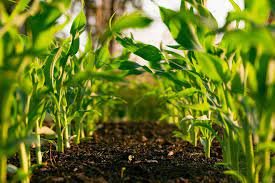
ORGANIC FARMING
COURTESY : ORGANIC FARMING
History
Agriculture was practiced for thousands of years without the use of artificial chemicals. Artificial fertilizers were first developed during the mid-19th century. These early fertilizers were cheap, powerful, and easy to transport in bulk. Similar advances occurred in chemical pesticides in the 1940s, leading to the decade being referred to as the ‘pesticide era’. These new agricultural techniques, while beneficial in the short-term, had serious longer-term side-effects such as soil compaction, erosion, and declines in overall soil fertility, along with health concerns about toxic chemicals entering the food supply. In the late 1800s and early 1900s, soil biology scientists began to seek ways to remedy these side effects while still maintaining higher production.
In 1921 the founder and pioneer of the organic movement Albert Howard and his wife Gabrielle Howard, accomplished botanists, founded an Institute of Plant Industry to improve traditional farming methods in India. Among other things, they brought improved implements and improved animal husbandry methods from their scientific training; then by incorporating aspects of Indian traditional methods, developed protocols for the rotation of crops, erosion prevention techniques, and the systematic use of composts and manures. Stimulated by these experiences of traditional farming, when Albert Howard returned to Britain in the early 1930s he began to promulgate a system of organic agriculture.
In 1924 Rudolf Steiner gave a series of eight lectures on agriculture with a focus on influences of the moon, planets, non-physical beings and elemental forces. They were held in response to a request by adherent farmers who noticed degraded soil conditions and a deterioration in the health and quality of crops and livestock resulting from the use of chemical fertilizers. The lectures were published in November 1924; the first English translation appeared in 1928 as The Agriculture Course.
In July 1939, Ehrenfried Pfeiffer, the author of the standard work on biodynamic agriculture (Bio-Dynamic Farming and Gardening), came to the UK at the invitation of Walter James, 4th Baron Northbourne as a presenter at the Betteshanger Summer School and Conference on Biodynamic Farming at Northbourne’s farm in Kent. One of the chief purposes of the conference was to bring together the proponents of various approaches to organic agriculture in order that they might cooperate within a larger movement. Howard attended the conference, where he met Pfeiffer. In the following year, Northbourne published his manifesto of organic farming, Look to the Land, in which he coined the term “organic farming”. The Betteshanger conference has been described as the ‘missing link’ between biodynamic agriculture and other forms of organic farming.
In 1940 Howard published his An Agricultural Testament. In this book he adopted Northbourne’s terminology of “organic farming”. Howard’s work spread widely, and he became known as the “father of organic farming” for his work in applying scientific knowledge and principles to various traditional and natural methods. In the United States J. I. Rodale, who was keenly interested both in Howard’s ideas and in biodynamics, founded in the 1940s both a working organic farm for trials and experimentation, The Rodale Institute, and Rodale, Inc. in Emmaus, Pennsylvania to teach and advocate organic methods to the wider public. These became important influences on the spread of organic agriculture. Further work was done by Lady Eve Balfour (the Haughley Experiment) in the United Kingdom, and many others across the world.
The term “eco-agriculture” was coined in 1970 by Charles Walters, founder of Acres Magazine, to describe agriculture which does not use “man-made molecules of toxic rescue chemistry”, effectively another name for organic agriculture.
Increasing environmental awareness in the general population in modern times has transformed the originally supply-driven organic movement to a demand-driven one. Premium prices and some government subsidies attracted farmers. In the developing world, many producers farm according to traditional methods that are comparable to organic farming, but not certified, and that may not include the latest scientific advancements in organic agriculture. In other cases, farmers in the developing world have converted to modern organic methods for economic reasons.
Terminology
The use of “organic” popularized by Howard and Rodale refers more narrowly to the use of organic matter derived from plant compost and animal manures to improve the humus content of soils, grounded in the work of early soil scientists who developed what was then called “humus farming”. Since the early 1940s the two camps have tended to merge.
Biodynamic agriculturists, on the other hand, used the term “organic” to indicate that a farm should be viewed as a living organism, in the sense of the following quotation:
“An organic farm, properly speaking, is not one that uses certain methods and substances and avoids others; it is a farm whose structure is formed in imitation of the structure of a natural system that has the integrity, the independence and the benign dependence of an organism”
They based their work on Steiner’s spiritually-oriented alternative agriculture which includes various esoteric concepts.
# artificial chemicals
#humus farming
#ISBC

You may also like

Urban heat local food production
Vibrant Agro industry

