
Test of green buildings lie in optimising resource and energy use
Courtesy : The Indian express
Test of green buildings lie in optimising resource and energy use
The Indian attitude towards green building has inherently been different from the western model of green building which is equipment centric.
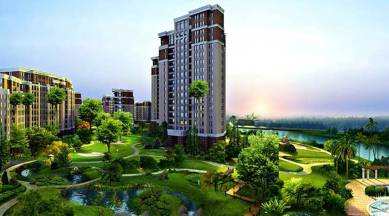
A green development or building can be defined as one which depletes as little of the natural resources during its construction and operation.
Written by Manit Rastogi
Over the past two decades, the words, ‘Green’ and ‘Sustainable construction’ have evolved from a fringe movement to achieving mainstream status. Almost everyone and all products from various spheres of life claim to be “sustainable”. The ‘Green’ industry has turned the ideology from being ‘a way of life’ to a mere marketing tool. There is no doubt that buildings contribute to over 40 per cent of all carbon emissions in the world and therefore, must be green to be sustainable. To outpace global warming, we need to change the way we think, from the highest levels of government, policy and education to the grassroots levels of the common man. This cannot be achieved as isolated events. The biggest challenge we are faced with today is to find a model of sustainable urbanism, architecture, and design.
The built environment is one of the largest consumers of energy. Traditional Indian architecture has always been green. It is suited to local contexts and a response to paucity of resources. The Indian attitude towards green building has inherently been different from the western model of green building which is equipment centric.
Reaping benefits of the oil boom in the post 60’s, with energy being easily and cheaply available, there was an evolution of equipment-centric hermetically sealed buildings in several parts of the world; these were disconnected from the environment. Today, this has been further compounded by non-localised green rating systems which although aim to provide better environments, but the methodology adopted by these systems is equipment centric, restricted and highly prescriptive. This results in limited application owing to the non-recognition of the varying climatic zones and the prescribed narrow definition of human comfort level ranging between only a few degrees delinked from the external environment.
Developments across India, perhaps even throughout the world, are designed with a layer of sustainability or ‘green’ superimposed on it. However, there must be a conscious attempt to step away from this system and incorporate passive design approaches to design right from the conceptual and planning stages. A green development or building can be defined as one which depletes as little of the natural resources during its construction and operation. Hence, a critical position needs to be established that will intrinsically inform sustainability with regards to contemporary Indian architecture. This should aim to reduce the load on the environment in its construction strategy (assembly), material resource utilisation (transportation), spatial allocation (area optimisation), energy consumption and therefore increasingly rely on natural environmental resources and renewables such as daylighting, ventilation, passive methods of cooling, water recycling and access to nature.
An effective way to deal with our eroding ecosystems in a sustainable manner is to take a socio- contextual approach that assimilates the learnings of our past with cutting edge modern technology. Traditional Indian architecture has been more often than not adopted passive solutions which further help to reduce energy dependence by increasing the number of comfortable habitable hours without reliance on mechanical means. Optimisation of all resources is a pre-requisite to responsible architecture today. Unlike other nations, local resources and methods of construction are still easily available to us. The most effective approach is to build with local materials in a manner that responds to the climatic needs of the region while remaining economically viable. Additionally, the green rated materials available today, further reduce the embodied energy of the finished product. Low energy materials when used at all stages of the building construction process – civil construction, interiors and landscape design can aid in reducing the overall impact of materials on health and environment. By closed loop recycling, conserving natural resources, elimination of products with bio-accumulative toxins and minimising waste to landfill, we can significantly reduce carbon footprint of our built environment.
Buildings shouldn’t be just energy efficient during the operational phase, but from concept to completion and to the entire lifecycle of a building. For energy conservation during construction phase, it’s imperative to address the impact of heavy machinery, transportation of materials and waste generation and its safe disposal.
The idea of sustainability should now move on from buildings to our cities as well. We believe urbanisation, environmental sensitivity and a greener world are core issues that need to be assimilated in our thinking and consciousness, and need to be addressed today and in the future. We need to consciously work towards global, financial and economic models of development to build a sustainable economy. We need to model solutions that are comprehensive and easily applicable at the grassroots level.

You may also like

Urban heat local food production
Vibrant Agro industry

