
Permaculture
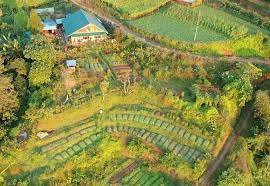
Permaculture
courtesy : Permaculture
Permaculture
Permaculture is an approach to land management and settlement design that adopts arrangements observed in flourishing natural ecosystems. It includes a set of design principles derived using whole-systems thinking. It applies these principles in fields such as regenerative agriculture, town planning, rewilding, and community resilience. Permaculture originally came from “permanent agriculture”, but was later adjusted to mean “permanent culture”, incorporating social aspects. The term was coined in 1978 by Bill Mollison and David Holmgren, who formulated the concept in opposition to modern industrialized methods instead adopting a more traditional or “natural” approach to agriculture. Permaculture has many branches including ecological design, ecological engineering, regenerative design, environmental design, and construction. It also includes integrated water resources management, sustainable architecture, and regenerative and self-maintained habitat and agricultural systems modeled from natural ecosystems. Permaculture uses creative design processes based on whole-systems thinking, considering all materials and energies in flow that affect or are affected by proposed changes. In practical terms it means that before, for example, modifying overland water flow, one fully considers both upstream and downstream effects in the short and long terms. Or, when looking at a “problem”, such as brushy vegetation, one considers how removing or altering it will affect soil and wildlife, and how these interacting forces would evolve over time and space.
#permanent agriculture
#permanent culture
Foundational ethics
The ethics on which permaculture builds are:
- “Care of the Earth: Provision for all life systems to continue and multiply”.
- “Care of people: Provision for people to access those resources necessary for their existence”
- “Setting limits to population and consumption: By governing our own needs, we can set resources aside to further the above principles” Mollison
Mollison’s 1988 formulation of the third ethic was restated by Holmgren in 2002 as “Set limits to consumption and reproduction, and redistribute surplus”.
Permaculture emphasizes patterns of landscape, function, and species assemblies. It determines where these elements should be placed so they can provide maximum benefit to the local environment. Permaculture maximizes useful connections between components and synergy of the final design. The focus of permaculture, therefore, is not on individual elements, but rather on the relationships among them. Properly done, the whole becomes greater than the sum of its parts. Permaculture seeks to minimize waste, human labor, and energy input and maximize benefits through synergy.
Permaculture design is founded in replicating or imitating natural patterns found in ecosystems because these solutions have emerged through evolution over thousands of years and have proven to be effective. As a result, the implementation of permaculture design will vary widely depending on the region of the Earth it is located in. Because permaculture’s implementation is so localized and place specific, scientific literature for the field is lacking or not always applicable. Design principles derive from the science of systems ecology and the study of pre-industrial examples of sustainable land use. Permaculture draws from disciplines including organic farming, agroforestry, integrated farming, sustainable development, physics, meteorology, sociology, anthropology, biochemistry, engineering, and applied ecology.
#Permaculture
#ISBC

You may also like

Urban heat local food production
Vibrant Agro industry

