
Natural gas
Natural gas
courtesy : Natural gas
INFORMATION
In the 19th century, natural gas was primarily obtained as a by-product of producing oil. The small, light gas carbon chains came out of solution as the extracted fluids underwent pressure reduction from the reservoir to the surface, similar to uncapping a soft drink bottle where the carbon dioxide effervesces. The gas was often viewed as a by-product, a hazard, and a disposal problem in active oil fields. The large volumes produced could not be utilized until relatively expensive pipeline and storage facilities were constructed to deliver the gas to consumer markets.
Until the early part of the 20th century, most natural gas associated with oil was either simply released or burned off at oil fields. Gas venting and production flaring are still practised in modern times, but efforts are ongoing around the world to retire them, and to replace them with other commercially viable and useful alternatives. Unwanted gas (or stranded gas without a market) is often returned to the reservoir with ‘injection’ wells while awaiting a possible future market or to re-pressurize the formation, which can enhance oil extraction rates from other wells. In regions with a high natural gas demand (such as the US), pipelines are constructed when it is economically feasible to transport gas from a wellsite to an end consumer.
In addition to transporting gas via pipelines for use in power generation, other end uses for natural gas include export as liquefied natural gas (LNG) or conversion of natural gas into other liquid products via gas to liquids (GTL) technologies. GTL technologies can convert natural gas into liquids products such as gasoline, diesel or jet fuel. A variety of GTL technologies have been developed, including Fischer–Tropsch (F–T), methanol to gasoline (MTG) and syngas to gasoline plus (STG+). F–T produces a synthetic crude that can be further refined into finished products, while MTG can produce synthetic gasoline from natural gas. STG+ can produce drop-in gasoline, diesel, jet fuel and aromatic chemicals directly from natural gas via a single-loop process. In 2011, Royal Dutch Shell’s 140,000 barrels (22,000 m3) per day F–T plant went into operation in Qatar.
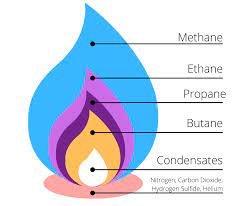
Natural gas can be “associated” (found in oil fields), or “non-associated” (isolated in natural gas fields), and is also found in coal beds (as coalbed methane). It sometimes contains a significant amount of ethane, propane, butane, and pentane—heavier hydrocarbons removed for commercial use prior to the methane being sold as a consumer fuel or chemical plant feedstock. Non-hydrocarbons such as carbon dioxide, nitrogen, helium (rarely), and hydrogen sulfide must also be removed before the natural gas can be transported.
Natural gas extracted from oil wells is called casinghead gas (whether or not truly produced up the annulus and through a casinghead outlet) or associated gas. The natural gas industry is extracting an increasing quantity of gas from challenging resource types: sour gas, tight gas, shale gas, and coalbed methane.
There is some disagreement on which country has the largest proven gas reserves. Sources that consider that Russia has by far the largest proven reserves include the US CIA (47,600 km3), the US Energy Information Administration (47,800 km3), and OPEC (48,700 km3). However, BP credits Russia with only 32,900 km3, which would place it in second place, slightly behind Iran (33,100 to 33,800 km3, depending on the source).
Countries by natural gas proven reserves (2014), based on data from The World Factbook
It is estimated that there are about 900,000 km3 of “unconventional” gas such as shale gas, of which 180,000 km3 may be recoverable. In turn, many studies from MIT, Black & Veatch and the DOE predict that natural gas will account for a larger portion of electricity generation and heat in the future.
#Natural gas
#underwent pressure reduction
#carbon dioxide
#IGBC

You may also like

Urban heat local food production
Vibrant Agro industry

