
Moon’s south pole has deep secrets, Chandrayaan-1 helps unravel lunar mystery
Courtesy : Indiatoday
Moon’s south pole has deep secrets, Chandrayaan-1 helps unravel lunar mystery
The lunar south pole harbours answers to some of the biggest questions, including how the Moon was formed in the first place and how other worlds in the solar system evolved

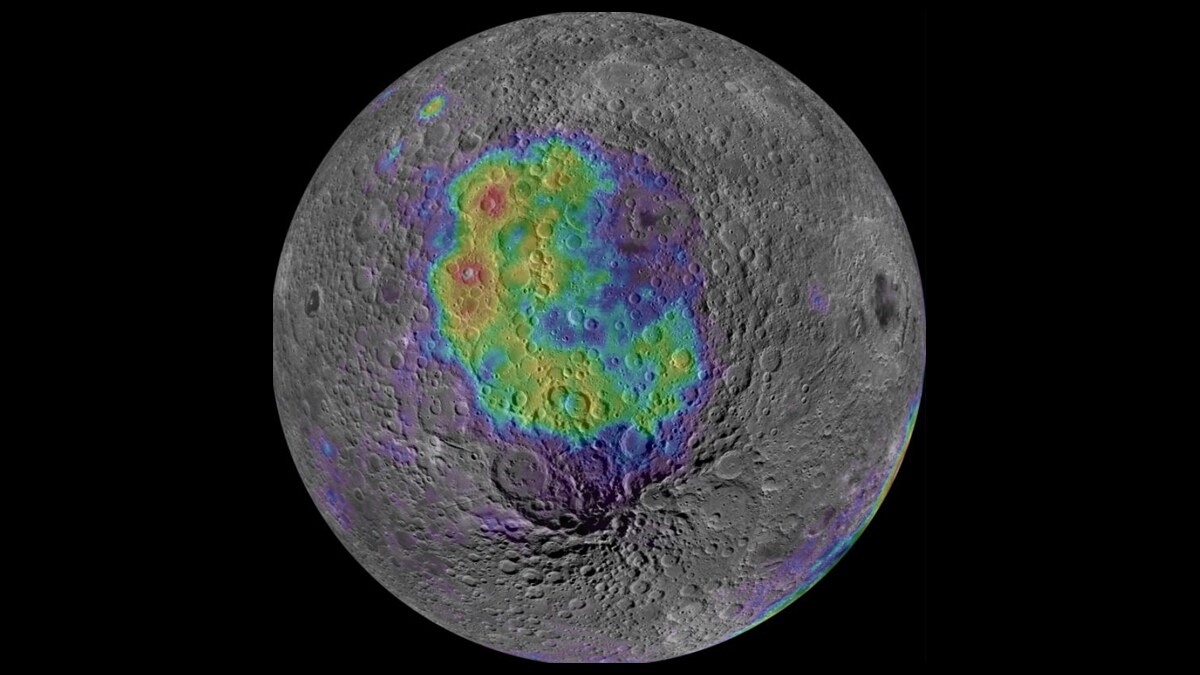
As countries rush to dominate the new age space race, the Moon has emerged as a hot piece of real estate that could act as a base for deeper exploration of the universe as humans vie to become an interplanetary species. But it could also be the site of some rare Earth minerals and resources.
Researchers have identified the lunar south pole as a prime location that could harbour these materials and resources while hiding some of the biggest secrets of Earth’s natural satellite including answers to how it was formed in the first place and how other worlds in the solar system evolved.
The answer could be in the pieces of the Moon’s interior scattered on the surface.
Researchers developed a new understanding of the lunar surface by studying recent observations made by spacecraft hovering in its orbit as well as the Moon Mineralogy Mapper that was on board India’s Chandrayaan-I impact probe. The research, published in Nature Communications and the Journal of Geophysical Research, states that the lunar surface is ancient and well-preserved, which has records of Solar System history and planetary evolution processes.

MAGMA OCEANS ON THE MOON
Shortly after it was formed, the Moon was a global ocean of molten magma that cooled, solidified and the dense minerals sank to form the mantle layer. However intense bombardment by massive asteroids and comets punched through the crust, blasting out pieces of the mantle and scattering them on the surface. Nasa now aims to collect these mantle pieces to be returned to Earth that can provide a better understanding of how the Moon and our planet evolved over the millennium.

DESIGNING LUNAR MAP
The new understanding of the lunar mantle was developed as the team reviewed the most recent laboratory experiments, lunar sample analysis, geophysical and geochemical models of the Moon. Combining this new understanding with the recent observations of the lunar surface from NASA’s Lunar Prospector and Lunar Reconnaissance Orbiter spacecraft, and the Moon Mineralogy Mapper instrument onboard Chandrayaan-I, they generated a map of likely mantle locations using Moon Mineralogy Mapper data to assess mineral composition and abundance.
Researchers integrated the mantle locations with Lunar Prospector observations of elemental abundances, including markers of the last remaining liquid at the end of lunar magma ocean crystallisation and found that the South Pole Aitken basin on the Moon, which is about 2,600 kilometres across is the most likely place to find pieces of the mantle.
“This northwest region of the South Pole Aitken Basin is the best location to access excavated mantle materials currently on the lunar surface. Interestingly, some of these materials may also be present around the proposed Artemis and VIPER landing sites around the lunar South Pole,” said Moriarty.
The basin is the largest confirmed impact structure on the Moon and therefore is associated with the deepest depth of excavation of all lunar basins.

You may also like

Urban heat local food production
Vibrant Agro industry

