India infrastructure master plan
Couertsy: india.gov.in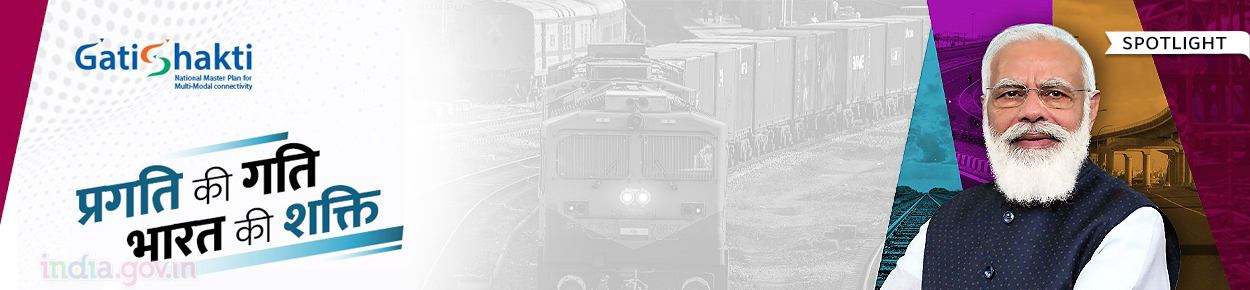
Prime Minister launched PM Gati Shakti – National Master Plan for Multi-modal Connectivity, essentially a digital platform to bring 16 Ministries including Railways and Roadways together for integrated planning and coordinated implementation of infrastructure connectivity projects.The multi-modal connectivity will provide integrated and seamless connectivity for movement of people, goods and services from one mode of transport to another. It will facilitate the last mile connectivity of infrastructure and also reduce travel time for people.
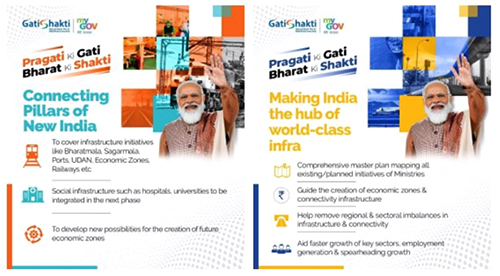
PM Gati Shakti will incorporate the infrastructure schemes of various Ministries and State Governments like Bharatmala, Sagarmala, inland waterways, dry/land ports, UDAN etc. Economic Zones like textile clusters, pharmaceutical clusters, defence corridors, electronic parks, industrial corridors, fishing clusters, agri zones will be covered to improve connectivity & make Indian businesses more competitive. It will also leverage technology extensively including spatial planning tools with ISRO (Indian Space Research Organisation) imagery developed by BiSAG-N (Bhaskaracharya National Institute for Space Applications and Geoinformatics). More details of the Plan can be found here.
HISTORY & STEPS TO OVERCOME CHALLENGES
Traditionally, there was lack of coordination between different Departments, for example, once a road was constructed, other agencies dug up the constructed road again for activities like laying of underground cables, gas pipelines etc. This not only caused great inconvenience but was also a wasteful expenditure. To address this, efforts were made to increase coordination so that all cables, pipelines etc. could be laid simultaneously. Steps have also been taken to address other issues like time-taking approval process, multiplicity of regulatory clearances etc. In the last few years, the Government has ensured unprecedented focus on infrastructure through a holistic outlook. This helps to address the past issues through institutionalizing holistic planning for stakeholders for major infrastructure projects. Instead of planning & designing separately in silos, the projects will be designed and executed with a common vision.

You may also like
Urban heat local food production
Vibrant Agro industry