
Hubble telescope searches for aftermath of rare double star explosion
Courtesy : Space
Hubble telescope searches for aftermath of rare double star explosion
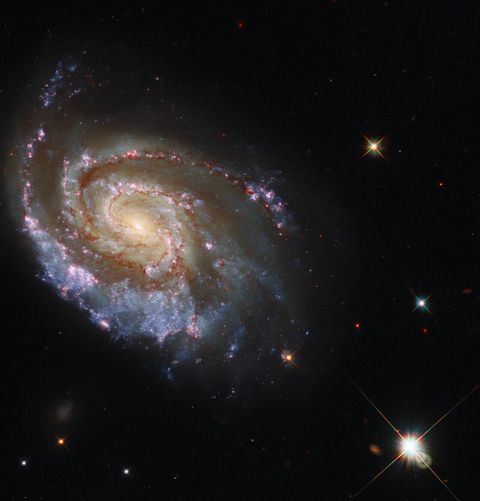 A newly released Hubble Space Telescope image shows galaxy NGC 6984, which is located about 200 million light-years from Earth. (Image credit: ESA/Hubble & NASA, D. Milisavljevic)
Stellar explosions are messy affairs, so two consecutive supernovas in the same galaxy are bound to leave a mark.
That’s the story behind a dramatic new Hubble Space Telescope image of a galaxy called NGC 6984 that the European Space Agency (ESA), which helps operate the observatory, released on Monday (Nov. 1). The image offers an entrancing view of the galaxy’s swirling arms, full of stars and star-forming regions.
The release doesn’t specify when the new data was captured but notes that the observations came after astronomers noticed an exceedingly rare double supernova in the galaxy. A supernova occurs when a relatively large star runs out of fuel and explodes, flinging material across the neighborhood.
Related: The best Hubble Space Telescope images of all time!
“The discovery of two supernovas at virtually the same time and location (in astronomical terms) prompted speculation from astronomers that the two supernovas may somehow be physically linked,” ESA officials wrote in the statement.
So the astronomers enlisted Hubble’s Wide Field Camera 3 to observe the galaxy in ultraviolet and visible light to examine the strange coincidence.
Galaxy NGC 6984 is located in the constellation Indus and lies about 200 million light-years away from Earth, according to the statement.
Hubble previously observed the galaxy in 2013, ESA noted, so the new observations can also be paired with archival data. The newly released image represents the combination of old and new data.

You may also like

Urban heat local food production
Vibrant Agro industry

