
Hubble Space Telescope: Pictures, Facts & History
courtesy: SPACE
Hubble Space Telescope: Pictures, Facts & History
Since its launch in 1990, the Hubble Space Telescope (HST) has provided a dazzling array of images that have awed and inspired the public. More than just pretty pictures, the dozens of terabytes of data collected has provided insight into the universe, from objects as close as the moon to the most remote galaxies, with incredible photos of supernovas and nebulas in between.
Here we explore the history of the telescope and its discoveries, provide Hubble facts and links to some of the orbiting observatory’s best images.
Related: The best Hubble Space Telescope Images of all time!
Getting Hubble off the ground
When Galileo first turned a spyglass to the heavens in 1610, he had trouble making out the rings of Saturn that are visible in inexpensive telescopes today. Advances in optics eventually improved scientists’ views of the planets, stars and distant galaxies, but Earth’s atmosphere still blocked much of the light for observers on the ground. Larger telescopes were, and still are placed atop mountains, where the thinner atmosphere at higher elevations allows clearer pictures.
In 1946, soon after World War II, astronomer Lyman Spitzer proposed launching a space telescope, which could overcome the limitations of ground-based observatories. It took a couple more decades before the idea garnered enough support for the National Academy of Science to organize a committee of scientists to evaluate the potential of a Large Space Telescope. With Spitzer at the helm, the committee published a document in 1969 that outlined the scientific uses of a Large Space Telescope and advocated for its construction, according to a history of the telescope written by Gabriel Olkoski for NASA.
The National Academy of Science took their pitch to NASA — the only agency capable of making the Large Space Telescope a reality. NASA was already considering a space telescope of some type, but they were undecided on how big to make it and where to start. In 1971, George Low, the agency’s acting administrator at that time, greenlighted the Large Space Telescope Science Steering Group and NASA soon began lobbying Congress for funding for the endeavor.
The expensive project was a tough sell, and funding was initially denied by the House Appropriations Subcommittee in 1975. NASA then upped their lobbying efforts and got buy-in from European Space Agency, which shared the costs. Congress eventually granted funding for NASA’s portion of the Large Space Telescope in 1977.
Development began almost immediately, and NASA planned to launch the telescope in 1983, but various production delays pushed the launch date back to 1986.
In the meantime, the Large Space Telescope was renamed the Hubble (HST) in honor of Edwin Hubble, an American astronomer who, among other things, determined that the universe extended beyond the borders of the Milky Way.
The HST was delayed once more after the 1986 space shuttle Challenger exploded a minute after takeoff on January 28 of that year, killing all seven astronauts on board. It took two years before shuttle flights could resume and NASA could begin planning Hubble’s launch again.
The world’s first space telescope finally launched aboard space shuttle Discovery on April 24, 1990. The effort cost $1.5 billion, but there would be ongoing costs — both
Initial instruments on Hubble included the Wide Field Planetary Camera, the Goddard High Resolution Spectrograph (GHRS), the Faint Object Camera (FOC), the Faint Object Spectrograph (FOS) and the High Speed Photometer.
Hubble experienced equipment issues right off the bat. The telescope’s images came back so blurry that they were close to useless. Hubble’s main mirror had a defect — a spherical aberration caused by a manufacturing error. The flaw was minute, at just 1/50th the thickness of a sheet of paper, but that was big enough to cause major imaging problems.
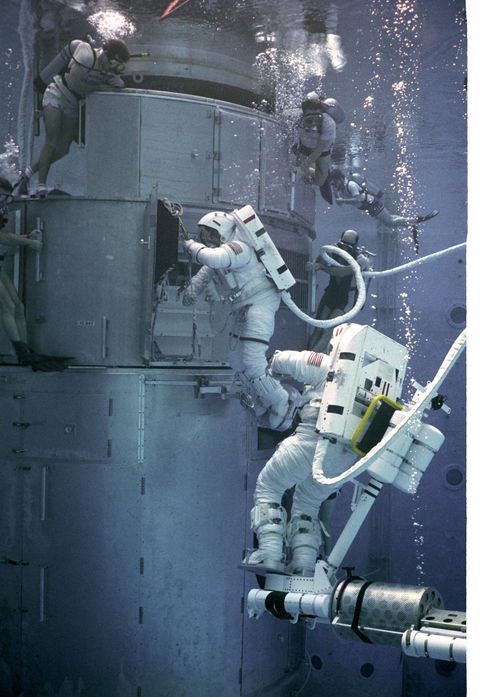
It took three years before NASA could mount a repair mission. On Dec. 2, 1993, the Space Shuttle Endeavor ferried a crew of seven to fix Hubble during five days of spacewalks. Two new cameras, including the Wide-Field Planetary Camera 2 (WFPC-2) — which later took many of Hubble’s most famous photos — were installed during the fix. In December 1993, the first new images from Hubble reached Earth, and they were breathtaking.
Since then, Hubble has continued to provide unprecedented information about our universe and inspire curious minds around the world.
The expensive project was a tough sell, and funding was initially denied by the House Appropriations Subcommittee in 1975. NASA then upped their lobbying efforts and got buy-in from European Space Agency, which shared the costs. Congress eventually granted funding for NASA’s portion of the Large Space Telescope in 1977.
Development began almost immediately, and NASA planned to launch the telescope in 1983, but various production delays pushed the launch date back to 1986.
In the meantime, the Large Space Telescope was renamed the Hubble (HST) in honor of Edwin Hubble, an American astronomer who, among other things, determined that the universe extended beyond the borders of the Milky Way.
The HST was delayed once more after the 1986 space shuttle Challenger exploded a minute after takeoff on January 28 of that year, killing all seven astronauts on board. It took two years before shuttle flights could resume and NASA could begin planning Hubble’s launch again.
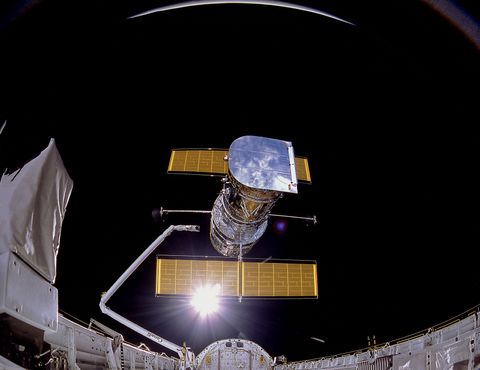
The world’s first space telescope finally launched aboard space shuttle Discovery on April 24, 1990. The effort cost $1.5 billion, but there would be ongoing costs — both expected and unexpected.
Hubble experienced equipment issues right off the bat. The telescope’s images came back so blurry that they were close to useless. Hubble’s main mirror had a defect — a spherical aberration caused by a manufacturing error. The flaw was minute, at just 1/50th the thickness of a sheet of paper, but that was big enough to cause major imaging problems.
It took three years before NASA could mount a repair mission. On Dec. 2, 1993, the Space Shuttle Endeavor ferried a crew of seven to fix Hubble during five days of spacewalks. Two new cameras, including the Wide-Field Planetary Camera 2 (WFPC-2) — which later took many of Hubble’s most famous photos — were installed during the fix. In December 1993, the first new images from Hubble reached Earth, and they were breathtaking.
Since then, Hubble has continued to provide unprecedented information about our universe and inspire curious minds around the world.
Hubble facts
The Hubble is a joint project between NASA and the European Space Agency. Here are some basic facts about the telescope and the mission, courtesy of the Space Telescope Science Institute (STScI), which operates Hubble for NASA:
Telescope size:
ubble has been serviced five times. Here are the highlights of each servicing mission:
- Servicing Mission 1 – STS-61, December 1993: A corrective optics package was installed, and the Wide Field Planetary Camera was replaced with the Wide Field and Planetary Camera 2 (including an internal optical correction system.) The computers were upgraded. The astronauts also replaced solar arrays, gyroscopes, magnetometers, computers and other equipment.
- Servicing Mission 2 – STS-82, February 1997: Among other tasks, astronauts installed the Space Telescope Imaging Spectrograph (STIS) and the Near Infrared Camera and Multi-Object Spectrometer (NICMOS), replacing the GHRS and the FOS. An unexpected problem with NICMOS shortened its expected lifespan to only 2 years, less than half of initial projections.
- Servicing Mission 3A – STS-103, December 1999: The third servicing mission was divided into two parts after three of the six gyroscopes (pointing devices) failed on Hubble. Just a few weeks before 3A lifted off, a fourth gyroscope failed and left the telescope unable to point in the right direction for observations. 3A replaced all the gyroscopes, a fine guidance sensor and the computer, among other tasks. The mission put Hubble back in service shortly after the repairs were completed.
- Servicing Mission 3B – STS-109, March 2002: This mission installed the Advanced Camera for Surveys (replacing the FOC), repaired NICMOS and replaced the solar arrays.
- Servicing Mission 4 – STS-125, May 2009: This mission was at first scheduled for February 2005, but NASA canceled it after the Columbia shuttle was dama

You may also like

Urban heat local food production
Vibrant Agro industry


1 Comment
Great work! This is the type of information that should be shared around the web. Shame on Google for not positioning this post higher! Come on over and visit my web site . Thanks =)