
Green zero discharge workplace
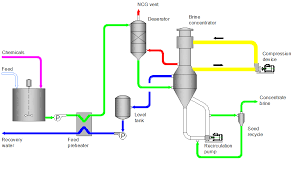
Green zero discharge workplace
courtesy : Green zero discharge workplace.
Introduction to Zero Liquid Discharge
Zero Liquid Discharge (ZLD) is a treatment process, which is designed to remove all the liquid waste from a system. Reduction of wastewater economically and producing clean water that is suitable for reuse (e.g. irrigation) is the main focus of ZLD. Water will be reused, hence, it saves money and is beneficial to the environment. ZLD systems employ advanced desalination/wastewater treatment technologies to purify and recycle wastewater produced in the industries.
ZLD technologies are useful in plants to meet water reuse requirements, thus enabling businesses to:
- Meet government regulations on wastewater discharge
- Achieve highest water recovery
The wastewater streams contain valuable materials such as potassium sulfate, sodium sulfate, gypsum, caustic soda and lithium, which are possible to treat and recover.
Use of thermal technologies such as Crystallizers, Evaporators (Multi Effect Distillation (MED), Multi Stage Flash (MSF) and Mechanical Vapor Compression (MCV) are the conventional ways to achieve zero liquid discharge. Government regulations on the discharge of brine due to its environmental effect caused, make ZLD a necessity.
Zero liquid discharge in the circular economy
The concept of circular economy pursues the production of goods and services with a parallel reduction in the use of the necessary resources: raw materials, water and energy. It consists in implementing a new model, closing the products, services, waste, materials, water and energy life cycle to make economic development sustainable.
In line with this concept, the European Commission (EC), through the Europe 2020 strategy, has established the effective use of resources as one of its flagship initiatives for smart, sustainable and inclusive growth. The strategy aims to build a framework to assist in the journey towards a more efficient economy, making it possible to improve financial results, boost innovation and competitiveness, guarantee the supply of resources and reduce its impact, especially the economic impact.
WATER REUSE AND REGENERATION
Within the context of the circular economy, the regeneration and reuse of water is a key tool in reducing consumption and preserving such a valuable resource. The EC’s current stance on water reuse is clear as to the challenge this represents for the future, both in the treatment of industrial and urban waste water. This position takes a central role in the Strategic Implementation Plan of the European Innovation Partnership on Water.
According to this proposal, reuse can be environmentally beneficial both in quantitative terms, as additional supply is not required, and in qualitative terms, as it reduces the pressure of waste water discharge in sensitive areas. In addition, water reuse often requires lower investment and energy costs than other sources such as desalination or interbasin transfer, contributing to a reduction in greenhouse gas emissions.
Maximising the reuse of wateris also a specific objective of the EC communication the Blueprint to safeguard Europe’s water resources.
In terms of industrial activity, it should be noted that optimising consumption and the reuse of water are already common practice in many sectors. Even so, the EC seeks to promote this through the inclusion of water reuse in best available techniques reference documents (BREF) for industrial sectors, within the framework.
Also worth highlighting is the continuing research and innovation in many issues related to the reuse and treatment of industrial waste water. In fact, the European Commission supports this work, especially that which aims to facilitate improvements to water treatment facilities, the development of smart technology and reduced energy consumption.
In this context, and due to the need in industry to reduce water consumption, the concept of zero liquid discharge (ZLD) was born years ago: This aims to reduce discharge from installations to an absolute minimum, minimising consumption and environmental impact.
#zero liquid discharge (ZLD)
#WATER REUSE AND REGENERATION
# Green zero discharge workplace
#IGBC

You may also like

Urban heat local food production
Vibrant Agro industry

