
Green Space is Good for Mental Health
Courtesy : earthobservatory.nasa.gov
Green Space is Good for Mental Health
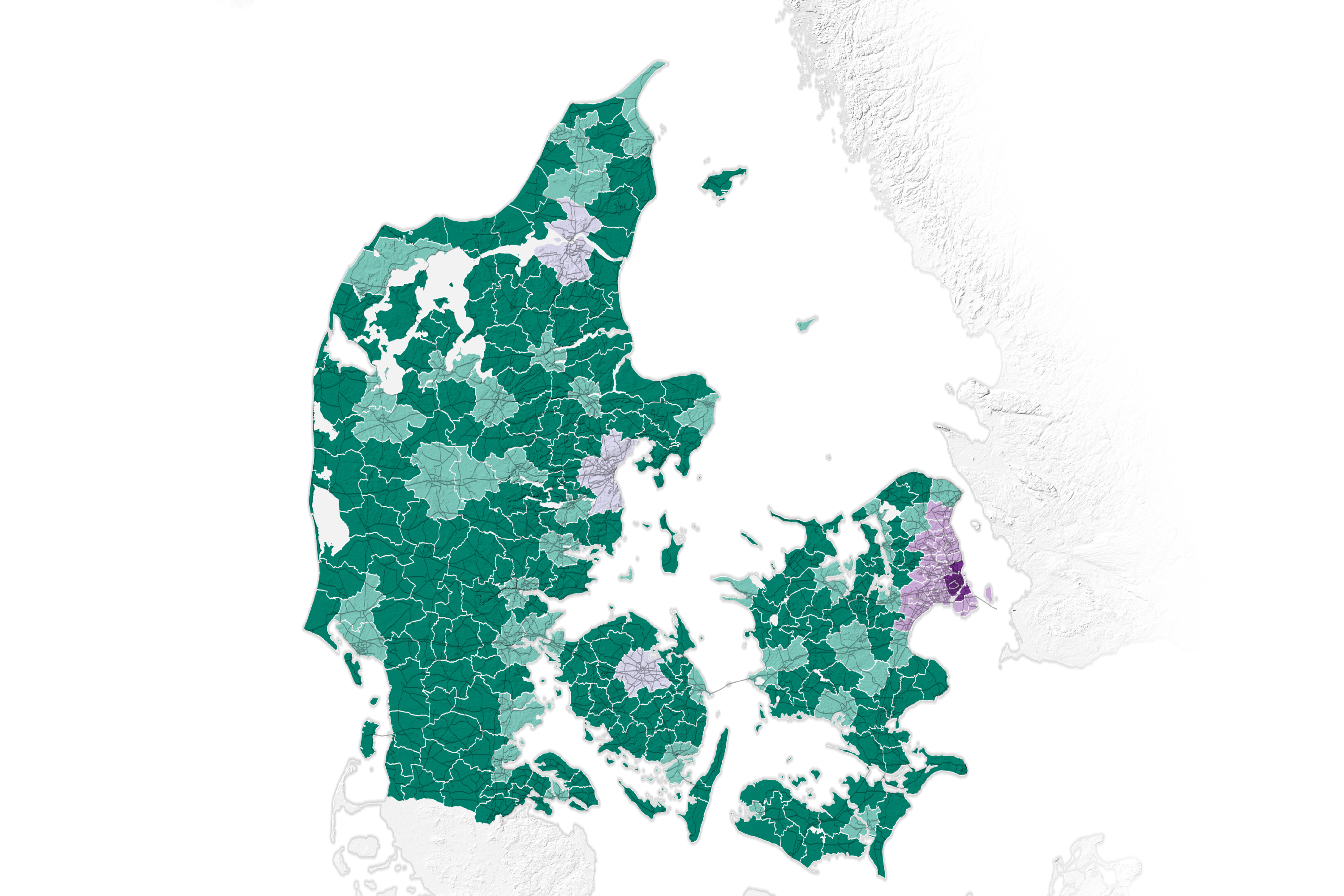
In a sweeping nationwide study, researchers from Denmark’s University of Aarhus found that childhood exposure to green space—parks, forests, rural lands, etc.—reduces the risk for developing an array of psychiatric disorders during adolescence and adulthood. The study could have far-reaching implications for healthy city design, making green space-focused urban planning an early intervention tool for reducing mental health problems.
Using data from the Landsat satellite archive and the Danish Civil Registration System, researchers tracked the residential green space around nearly a million Danes and correlated that with their mental health outcomes. The scientists found that citizens who grew up with the least green space nearby had as much as a 55 percent increased risk of developing psychiatric disorders such as depression, anxiety, and substance abuse in later years.
The research was published in the Proceedings of the National Academy of Sciences. It is the largest epidemiological study to document a positive connection between green space and mental health.
The impact of green space throughout childhood is significant. Exposure to green space is comparable to family history and parental age when predicting mental health outcomes. Only socioeconomic status was a slightly stronger indicator.
Researchers are still working out exactly why green space is so beneficial, but it clearly provides health benefits across the population. It can encourage exercise, provide spaces for socializing, decrease noise and air pollution, and improve immune function by providing exposure to beneficial microbiota. It also can help with psychological restoration; that is, green space provides a respite for over-stimulated minds.
Green space most strongly protects against mood disorders, depression, neurotic behavior, and stress-related issues, the study found, signaling that psychological restoration may be the strongest protective mechanism that green space offers. The effect of green space is also dose-dependent, meaning those who have longer exposures to green space have greater mental health benefits.
The map and line plots above describe the relationship between green space and relative mental health. The darkest greens on the map are the most rural or undeveloped areas, while the darkest purples are the most developed and paved urban centers. The line plots show the relative risk of developing a psychiatric disorder (vertical axis) versus the proximity to green space. Green space is defined by the Normalized Difference Vegetation Index (NDVI), a satellite measurement of the greenness of a parcel of land (with greenest areas to the right on the horizontal axis). Note how the mental health risks fall even in highly urbanized areas when a citizen lives close to a green space.
Previous research had already established that city living can increase the risk for some psychiatric disorders. While the specific mechanism behind the risk is unknown, those dwelling in cities have higher neural activity, which is linked to higher stress levels. With more than half of the world’s population now residing in cities—and that number is growing—health professionals are looking for ways to reduce the risk of psychiatric disorders that city living can cause.
While urban areas stand to benefit most from increased green space, this protective association is not just for city dwellers. The study found that longer exposure to green space was linked to bigger risk reductions from the city center to the rural outskirts. No upper limit to the benefit was found.
Two rich and extensive data sources made this research possible: the Danish register—which contains georeferenced addresses, health records, and socioeconomic data for citizens reaching back into the 1960s—and the long, global archive of 30-meter Landsat data. Researchers gathered information on more than 940,000 Danish citizens born between 1985 and 2003. The team then traced the proximity of those children to green space from birth to age 10, as well as their long-term mental health beyond age 10. To find the presence or absence of vegetation around each citizen’s home, Engemann and colleagues used Landsat to calculate NDVI, a ratio of how vegetation reflects or absorbs near-infrared light (which plants reflect strongly) versus visible red light (which plants largely absorb). Higher NDVI levels indicate a greener, more vegetated landscape.
“We decided to use Landsat data because it was free, high-resolution, and covered Denmark back to 1985,” lead author Kristine Engemann of Aarhus University explained. “The global geographic range together with free availability ensures that our study could potentially be repeated in other countries.”
NASA Earth Observatory image by Joshua Stevens, using data courtesy of Engemann, K., et al. (2019). Story by Laura Rocchio, Landsat Science Outreach Team, with Mike Carlowicz.

You may also like

Urban heat local food production
Vibrant Agro industry