
GReen data center
courtesy : techtarget
green data center
What is a green data center?
A green data center is a repository for the storage, management and dissemination of data in which the mechanical, lighting, electrical and computer systems are designed to maximize energy efficiency and minimize environmental impact. The construction and operation of a green data center includes advanced technologies and strategies.
The following are examples of some of the technologies and strategies used in green data centers:
- minimized building footprints;
- low-emission building materials, carpets and paints;
- sustainable landscaping;
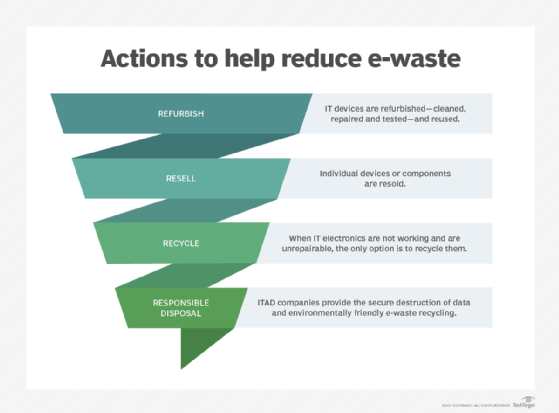
- e-waste recycling;
- catalytic converters on backup generators;
- alternative energy, such as photovoltaic technology, heat pumps and evaporative cooling technology; and
- hybrid or electric vehicles.
Building and certifying a green data center or other facility can be expensive upfront, but long-term cost savings can be realized on operations and maintenance. Another advantage is the fact that green facilities offer employees a healthy, comfortable work environment. Green facilities also enhance relations with local communities.
There is growing pressure from environmentalists and, increasingly, the general public for governments to offer green incentives. Companies sometimes receive tax incentives and other types of monetary support for the creation and use of environmentally responsible technologies.
Why have a green data center?
According to the Storage Networking Industry Association, energy consumption is one of the highest expenses of a data center. It is also among the top 10 issues that worry data center operators.
Adopting a green approach to data center energy and environment management can be a significant investment. However, over time, these data centers provide a range of advantages. Some benefits of green data centers are the following:
- lowers long-term operating costs;
- reduces space requirements;
- lowers carbon emissions;
- decreases water use;
- reduces waste output;
- cuts electricity consumption; and
- emphasizes use of renewable and sustainable data center
Green data center performance metrics
Two metrics have been developed to measure energy usage and sustainability. They are widely used to demonstrate and certify that buildings are using energy efficiently and don’t harm the environment.
Power usage effectiveness (PUE)
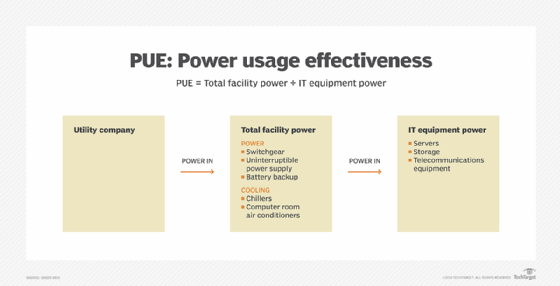
Developed in 1997, PUE measures the power consumption of a data center. It is the ratio of the power provided to the data center divided by the power the equipment in the data center uses. The goal is to have the ratio come as close as possible to one, which indicates effective power usage.
Carbon usage effectiveness (CUE)
This metric was developed by The Green Grid, which is part of the Information Technology Industry Council. CUE helps confirm whether a data center has attained its sustainability goals. It is the ratio of carbon dioxide emissions the data center generates divided by the energy consumption of data center equipment. The goal is to have the lowest possible value, which indicates that the data center is effectively controlling its carbon dioxide emissions and carbon footprint.
Two certifications are available to validate that a building or IT device is energy-efficient and environmentally friendly:
- Leadership in Energy and Environmental Design (LEED). The U.S. Green Building Council created this certification. LEED certification of a building means it has satisfied a rigorous set of criteria for lowering energy consumption and being environmentally friendly.
- Energy Star. Developed by the U.S. Environmental Protection Agency and the U.S. Department of Energy, the Energy Star designation certifies that something is energy-efficient. Use of Energy Star-certified products have saved residential and businesses users over 5 trillion kilowatts of electricity since 1992.

You may also like

Urban heat local food production
Vibrant Agro industry

