
food forest
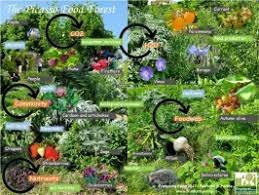
food forest
courtesy : food forest
What is a Food Forest?
This post, including photos and illustrations, are from Brook Artziniega who worked with us this summer. Before coming to us, Brook worked in film and podcasting production, most recently with the Peabody Award winning podcast, Threshold. This spring she completed her graduate work in the University of Montana’s Environmental Studies program.
Food forests are a relatively new addition to the mainstream edible landscaping conversation, but their cultivation is actually quite ancient. So, what are they?
“Food forests,” also called “forest gardens” or “edible forests,” is shorthand for the practice of cultivating forest ecosystems for human food production. Sometimes this looks like leveraging an existing forest to slowly integrate edible plants, but increasingly, it is the practice of imitating forest-like structures to increase the biodiversity, efficiency, and sustainability of food production systems.
There are two key features of a food forest: plant layers and plant types.
Plant layers exist to mimic the verticality of forests. While farms and gardens, as we have come to know them, tend to grow along the ground in long, flat planes, forests are far more three-dimensional. They grow out and up, with extensive layering from canopy to ground that allows for much more life in a single area.
This profusion of life is what makes forests such healthy places. In forests, things like pest-management, fertilization, weed suppression, pollination, and nitrogen-fixing are all happening naturally, as are greater eco-system functions, like water retention, carbon sequestration, and climate stabilization— and forest layers are what make that all possible.
#greater eco-system functions
#Environmental Studies program
#food forest
#ISBC

You may also like

Urban heat local food production
Vibrant Agro industry

