
Environment assessment and site selection
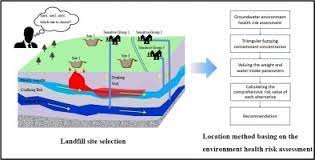
Environment assessment and site selection
courtesy : Environment assessment and site selection
Introduction
The 20th century has been regarded as the century of revolutions and overall growth. The 20th century has witnessed highest population, industrial, agriculture growth etc. The increase in
population at very rapid rates necessitated the requirements of more resources especially basic requirements of food, cloth and housing. In order to sustain the fast increasing population, the major focus of all the governments throughout the world was to increase agriculture production, setting up of industries, construction of houses and other infrastructure facilities. During the initial phases of overall growth, no importance was given to the ecological imbalance and environmental destruction. This overall growth does not come solely as blessing but took many challenges for the future generations. The major challenges for the world population are health, environment, and safety. The increased
pollution due to anthropogenic activities tend to increase the human concerns about the environment and sustainable living. The matter in the mid of 20th century was of major concern for most of the developed countries. Efforts were made by various International
organizations like United Nations Environment Program (UNEP), United Nations Industrial Development Organization (UNIDO) through decelerations to make some policies to decease the load of infrastructure activities on the environment and emphasized on sustainable development. The developed countries made various policies in this regard and started the process of conducting Environment Impact Assessment studies. In consistent to developing nations, India also took various steps by various acts, notifications and policies.
Evolution of EIA
EIA is a formal policy innovation for environmental conservation in many countries. The process of EIA first started in USA in the early 1970s with the implementation of the National Environment Policy Act (NEPA) 1969. The other developed or high-income
countries like Australia, Canada, and New Zealand also followed the footsteps of US and formally started the EIA. This was followed by other countries as well, which started EIA relatively early – Columbia (1974), Philippines (1978).This was further strengthened by the efforts of the World Bank which adopted EIA in 1989.
The World Bank made it necessary to undertake an EIA under the Bank’s supervision for all major development projects funded by them. The main strength came from the Rio Earth Summit (1992). After this the consolidation and international dissemination of environmental impact assessment was officially recognized as decision-making tool for sustainable development. The three documents of Rio viz. Principle 17, Article 14, and Agenda 21
played very important role for the consolidation of EIA. The Principle 17 of the Rio Declaration on Environment and Development states that “Environmental impact assessment, as a national instrument, shall be undertaken for proposed activities that are likely to have a significant adverse impact on the environment
and are subject to a decision of a competent national authority”.
The Article 14 (titled Impact Assessment and Minimizing Adverse Impacts) of the Convention on Biological Diversity states that ”Each Contracting Party, as far as possible and as appropriate, shall: (a) Introduce appropriate procedures requiring environmental impact
assessment of its proposed projects that are likely to have significant adverse effects on biological diversity with a view to avoiding or minimizing such effects and, where appropriate, allow for public participation in such procedures; (b) Introduce appropriate
arrangements to ensure that the environmental consequences of its programs and policies that are likely to have significant adverse impacts on biological diversity are duly taken into account”.
Similarly, Agenda 21 also refers about EIA in different chapters. The Chapter 8 of agenda 21 (titled Integrating environment and development in decision-making) recommends “environmental impact assessment should extend beyond the project level to policies and programs”. The Chapter 18 of agenda 21 titled “protection of the quality and supply of freshwater resources” discusses about application of integrated approaches to the
development, management and use of water resources Though it started in late 20th century still it has been managed to be practiced in more than 100 countries.
#United Nations Environment Program (UNEP)
#Environment assessment and site selection
#Evolution (EIA)
#introduction
#isbc

You may also like

Urban heat local food production
Vibrant Agro industry

