
City in a garden
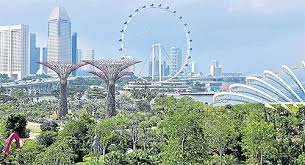
City in a garden
courtesy : City in a garden
The Garden City vs. the Green City
Pop culture’s interpretation of “green” urban landscapes have a tendency to draw a literal representation of a more sustainable city. These “Garden City” visions can include plants growing from virtually every spatial nook and cranny possible. With flowing strands of climbing plants scaling facades and trees not only lining the streets, but poking out of sky gardens stories off of the ground, the idea of a more environmentally responsible cityscape is often presented to the public as being the result of the integration of flora and fauna. While incorporating foliage and creating micro-climates carry a number of benefits, a truly green city has to revolve around the integration of systems to help it emulate a natural ecology. Plants should be treated as one component of a network of sustainable efforts in order to be properly utilized. This vision is not really “wrong” as much as incomplete and runs the risk of misleading people into thinking that making cities sustainable is as simple as adding plant life. There is no real solution that involves only planting our way to stewardship.
The Source of the Garden City
The notion of a garden city is not new. With icons as old as the Hanging Gardens of Babylon, the introduction of heavily planted cities has tried to capture the impressive nature of constructed urban density and scale but soften it into a picture of the natural landscape. We associate planted landscapes with clean water, clean air and less noise. The attractiveness of the imagery is an attempt at trying to get the best of both worlds. The concept is certainly an emulation of the possibilities of cities as they were imagined by legendary landscape architect Frederick Law Olmsted that designed numerous parks across the U.S. and Canada including New York’s Central Park. Most of Olmsted’s career revolved around weaving parks and echoes of natural spaces into the urban fabric. A number of architects have tried to hazard an attempt at integrating the polar opposites of rural and urban environments. Frank Lloyd Wright’s scenic Broadacre City plan was built around the notion of an agrarian community integrated with its natural surroundings where every resident was given an acre of land to live. Depictions of life there had pastoral backdrops with more farmland than buildings and personal hovering vehicles dotting the horizon. Ironically, the design was markedly unsustainable in its vision. The city was not really a city at all. On the contrary, the plan was essentially a more rural incarnation of suburbia with its mobility built on the backs of the automobile and devoid of all the inherent sustainable opportunities that come with density. Decades later, architect Emilio Ambasz has crafted a large portion of his design practice around the infiltration of planted space into the city. The title page to his firm’s website proudly displays “green over the gray” as a banner of the mission in building design that culminated to the iconic Prefectural Hall in Fukuoka, Japan. Containing 1 million square feet, the building sits beneath a series of tiered, planted roofs to allow for the surface of an existing park to peel upwards from the street and create a cascading green waterfall over the structure. Behnisch’s design for the Daimler Headquarters pulls a planted gardens into the image of the building. As we get closer to the present, these examples grow in frequency. Behnisch Architects has consistently integrated plant life into their designs like a rendering of their new German headquaters for Daimler AG. The modern expression of clean glass is filled with skygardens inserted into the volume. A notion of sustainability becomes unmistakable—unsurprising for a car company in need of re-branding itself in the image of sustainability. The School of Art, Design and Media at Nanyang University goes a step further with its pair of undulating forms reminiscent of natural hills. Designed by CPG, the building’s continuous green roofs rise from the ground and return just as gently. These buildings unquestionably succeed in convincing the public they are green projects, but giving a buildings a biological hairdo does not a green city make. If it looks like you can scrape the greenery off without changing the building then you most likely actually can. A former employer referred to these tactics as “green eyebrows”, “growies” or a “growhawk.”
# City in a garden
#Pop culture’s interpretation of “green”
#Hanging Gardens
#echoes of natural spaces
#isbc

You may also like

Urban heat local food production
Vibrant Agro industry

