Adaptive Reuse as a Strategy for Sustainable Urban Development and Regeneration
Courtesy : Archdaily
Adaptive Reuse as a Strategy for Sustainable Urban Development and Regeneration

“New ideas must use old buildings,” said Jane Jacobs in her seminal book The Death and Life of Great American Cities, championing the reuse of existing building stock as a means to catalyze positive change and foster diverse urban environments. Inserting new activities within an existing framework is increasingly becoming a defining aspect of contemporary architecture, as the need for sustainable alternatives to building anew turns more urgent. From an urban perspective, adaptive reuse is a valuable strategy for revitalizing post-industrial cities, creating density and mitigating urban sprawl, or helping shrinking cities redefine their urban fabric.

At some point in recent history, the idea of architectural expendability has become acceptable, leading to an influx of one-generation structures. With the average lifespan of buildings in the developed world declining to 70 years, even going down to 30 years in places like Japan, there is an inherent expectation for obsolescence that needs to be called into question for environmental reasons. With over 2.5 billion people expected to live in urban areas by 2050 on the background of climate concerns and unsustainable levels of resource consumption, cities must find strategies to make the most out of the existing infrastructure and building stock. In recent years, adaptive reuse entered common practice, with established firms like MVRDV, Herzog and De Meuron or Heatherwck Studio championing the strategy through various projects. Along these lines, former AIA president Carl Elefante estimates that in the next few decades, adaptive reuse projects will be twice as numerous as new constructions.

In an interview, Winy Maas argued the necessity of adaptive reuse by saying that “For many ecological reasons — land and energy use, available infrastructure — it is better to have more intense environments than to continue the sprawl of suburbia. If you want to intensify existing cities, you have to deal with the existing built [environment].” The building stock is a resource for growth, and with the introduction of new elements, underused sites can become a point of social intensity.

In this sense, MVRDV’s Heuvelkwartier design reshapes the site of an outdated shopping centre in Eindhoven into an attractive cultural quarter by transforming and expanding the existing buildings. Similarly, EFFEKT recently won a competition to convert an urban block occupied by a decommissioned editorial office and printing press in Kiel, Germany. The project is meant to drive the revitalization of the city centre and shape a new cultural destination by infusing new programs within the existing structures and extending the built mass. In both of these cases, still, to be built, adaptive reuse at the scale of an urban block is the premise for urban regeneration.
Retrofit in Post-Industrial Landscapes
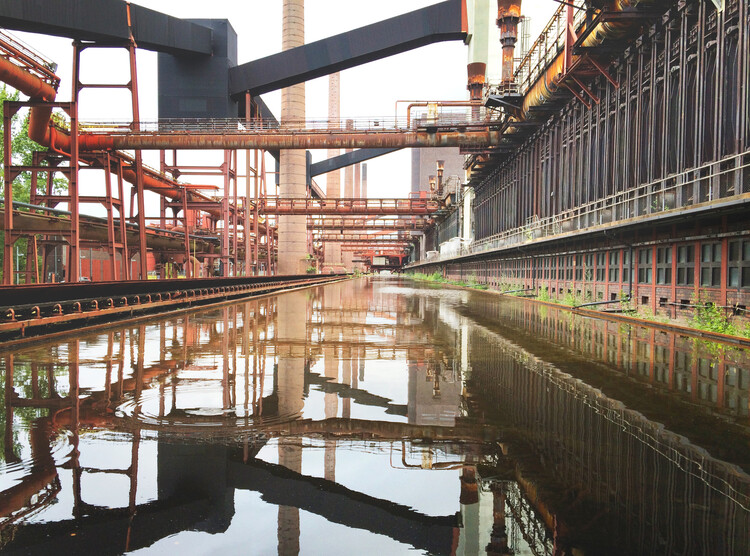
Originally built on the outskirts of cities, many industrial complexes have been engulfed by the sprawling urban environment. These brownfields and their machine-oriented architecture represent an important opportunity for cities to grow inward, building on the foundations of a robust yet flexible framework, whose sheer scale and established identity constitute arguments for adaptive reuse. The transformation of industrial areas gained momentum in the 1970s with the conversion of districts such as SoHo in New York and became increasingly important in the 1990s, especially in western Europe, driven by the transition from an industrial to an information society.

The adaptive reuse of industrial sites takes on a variety of forms, with a wide range of programs, scales, and intensities as shown by the culture and tourism-oriented redevelopment of the UNESCO heritage site of the Zollverein Coal Mine Industrial Complex in Germany, the transformation of the Kleefse Ward industrial park in the Netherlands into a tech campus or the redevelopment of the LXFactory in Lisbon into a shopping district. The scale of the investment and effort also varies. In the case of the Sulzerareal steel factory in Switzerland, grand redevelopment plans were replaced by the organic reoccupation of the complex by small enterprises. The site was rewoven into the urban fabric by redesigning interstitial areas into public spaces.
Reframing the Urban Fabric of Shrinking Cities
The shrinking city phenomenon is a process of urban decline with complex causes ranging from deindustrialization, internal migration to population decline. The strategies for addressing urban shrinkage usually takes on two distinct directions: imbracing de-urbanization through methods like rightsizing/smart shrinkage or re-inventing the city under new premises, both of which entail adaptive reuse. Rightsizing can sometimes involve demolition, but in more sustainable cases, the strategy capitalizes on overlooked assets in the city and allocates new urban uses to vacant sites, thus stabilizing neighborhoods through curating a programmatically diverse piece of the urban fabric.

With adaptive reuse becoming a staple of contemporary architecture, the topic needs further exploration on several levels, from the urban planning perspective to the design methodology, down to the technical aspects concerning obsolete structures. At the urban level, the phenomenon provides an opportunity for re-inventing the built environment through a process of layering and curation, leading to more diverse and architecturally rich cities.

You may also like

Urban heat local food production
Vibrant Agro industry