
Wild life
Wild life
courtesy : Wild life
Fauna
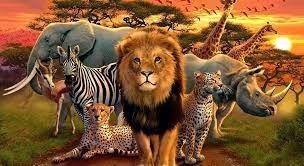
India is home to several well-known large animals, including the Indian elephant, Indian rhinoceros, Bengal tiger, Asiatic lion, Indian leopard, snow leopard, and clouded leopard. Bears include sloth bear, sun bear, the Himalayan black bear, the Himalayan brown bear, and deer and antelopes include the chausinga antelope, the blackbuck, chinkara gazelle, chital, sambar (deer), sangai, nilgai, Tibetan antelope, goa (antelope), Kashmir stag, musk deer, Indian muntjac, Indian hog deer, and the barasinga. It is home to big cats like Bengal tiger, Asiatic lion, Indian leopard, snow leopard, caracal, Eurasian lynx and clouded leopard. Various species of caprines, including Bhutan and Mishmi takin, Himalayan and red goral, Himalayan serow, red serow, Himalayan tahr, Siberian ibex, markhor, and Nilgiri tahr, as well as the kiang and Indian wild ass can be found. Wild sheep include blue sheep and argali. Gaur, wild water buffalo, wild yak, zebu, and gayal are also found. Small mammals include Indian crested porcupine, Indian boar, pygmy hog, Nilgiri marten, palm civet, red panda, binturong, and hog badger. Canidae include Tibetan and Bengal fox, Himalayan and Indian wolf, Ussuri Dhole and Indian Jackal. It is also home to the Striped Hyena. Aquatic mammals include Ganges river dolphin and finless porpoise. Reptiles include king cobra, Indian cobra, bamboo pit viper, Sri Lankan green vine snake, common krait, Indian rock python, Burmese python, reticulated python, mugger crocodile, gharial, saltwater crocodile and Indian golden gecko. Notable amphibians include the purple frog, Indian tree frog and Himalayan newt. Birds include Indian peacock, great Indian hornbill, great Indian bustard, ruddy shelduck, Himalayan monal, Himalayan quail, painted stork, greater and lesser flamingo, and Eurasian spoonbill.
#Fauna of India
#ISBC
Flora
There are about 18500 taxa of flowering plants from India. The Indian Forest Act, 1927 helped to improve the protection and security of the natural habitat. Many ecoregions, such as the shola forests, also exhibit extremely high rates of endemism; overall, 33% of Indian plant species are endemic. Flora and Vegetation of forest cover ranges from the tropical rainforest of the Andaman Islands, Western Ghats, and Northeast India to the coniferous forest of the Himalaya. Between these extremes lie the sal-dominated moist deciduous forest of eastern India; teak-dominated dry deciduous forest of central and southern India, and the babul-dominated thorn forest of the central Deccan and western Gangetic plain. Mangrove forests such as the Sundarbans are on the coasts of states like West Bengal and Odisha. Important Indian trees include the medicinal neem, widely used in rural Indian herbal remedies. Bamboo gardens are extremely common in jungles as well as villages. States like Sikkim and West Bengal have orchids. The national flower of India, the lotus flower, is common in lakes and ponds.
#The national flower of India
#Flora of India

You may also like

Urban heat local food production
Vibrant Agro industry

