
Global warming
Global warming
courtesy : Global warming
History
The existence of the greenhouse effect, while not named as such, was proposed by Joseph Fourier in 1824. The argument and the evidence were further strengthened by Claude Pouillet in 1827 and 1838. In 1856 Eunice Newton Foote demonstrated that the warming effect of the sun is greater for air with water vapour than for dry air, and the effect is even greater with carbon dioxide. She concluded that “An atmosphere of that gas would give to our earth a high temperature. John Tyndall was the first to measure the infrared absorption and emission of various gases and vapors. From 1859 onwards, he showed that the effect was due to a very small proportion of the atmosphere, with the main gases having no effect, and was largely due to water vapor, though small percentages of hydrocarbons and carbon dioxide had a significant effect. The effect was more fully quantified by Svante Arrhenius in 1896, who made the first quantitative prediction of global warming due to a hypothetical doubling of atmospheric carbon dioxide. However, the term “greenhouse” was not used to refer to this effect by any of these scientists; the term was first used in this way by Nils Gustaf Ekholm in 1901.
Definition
The IPCC Sixth Assessment Report working group 1 defines the greenhouse effect as:
The infrared radiative effect of all infrared-absorbing constituents in the atmosphere. Greenhouse gases (GHGs), clouds, and some aerosols absorb terrestrial radiation emitted by the Earth’s surface and elsewhere in the atmosphere. These substances emit infrared radiation in all directions, but, everything else being equal, the net amount emitted to space is normally less than would have been emitted in the absence of these absorbers because of the decline of temperature with altitude in the troposphere and the consequent weakening of emission. An increase in the concentration of GHGs increases the magnitude of this effect; the difference is sometimes called the enhanced greenhouse effect. The change in a GHG concentration because of anthropogenic emissions contributes to an instantaneous radiative forcing. Earth’s surface temperature and troposphere warm in response to this forcing, gradually restoring the radiative balance at the top of the atmosphere.
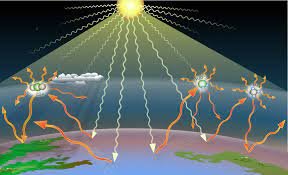
Earth receives energy from the Sun in the form of ultraviolet, visible, and near-infrared radiation. About 26% of the incoming solar energy is reflected back to space by the atmosphere and clouds, and 19% is absorbed by the atmosphere and clouds. Most of the remaining energy is absorbed at the surface of Earth. Because the Earth’s surface is colder than the Sun, it radiates at wavelengths that are much longer than the wavelengths that were absorbed. Most of this thermal radiation is absorbed by the atmosphere and warms it. The atmosphere also gains heat by sensible and latent heat fluxes from the surface. The atmosphere radiates energy both upwards and downwards; the part radiated downwards is abglobal warmingsorbed by the surface of Earth. This leads to a higher equilibrium temperature than if the atmosphere did not radiate.
An ideal thermally conductive blackbody at the same distance from the Sun as Earth would have a temperature of about 5.3 °C (41.5 °F). However, because Earth reflects about 30% of the incoming sunlight, this idealized planet’s effective temperature (the temperature of a blackbody that would emit the same amount of radiation) would be about −18 °C (0 °F). The surface temperature of this hypothetical planet is 33 °C (59 °F) below Earth’s actual surface temperature of approximately 14 °C (57 °F). The greenhouse effect is the contribution of greenhouse gases and aerosols to this difference, with imperfect modelling of clouds being the main uncertainty.
#definition of global warming
#History of climate change science
#global warming
#ISBC

You may also like

Urban heat local food production
Vibrant Agro industry

