courtesy :
The industry will become more environmentally friendly by regulation. The International Maritime Organization has proposed a 2020 Sulfur limit on the exhaust from the stacks of ocean-going ships. The IMO has called for ships to produce about 85 percent less sulfur by the end of next year, and to halve their total greenhouse-gas emissions by 2050.
The shipping industry is dynamic, and the growing demand for tank containers and the urgency to take measures for reducing the carbon footprint is substantial. The increasing standards made by the IMO have triggered research and development of “green” technology for the shipping industry. The shipping industry has to create and apply innovative measures in order to comply with the new regulations.
As an industry leader in marine cargo tank coatings, and filling the increased demand for high-performance tank linings, APC sees first-hand the evolution the industry is experiencing and the critical role we play in the maritime value chain. In this article, we have incorporated a number of industry developments and discussions from various sources about the value of a green ship and potential strategies to increase energy efficiency and decrease sulfur oxide (SOx).
But first…
What is Green Shipping / Green Marine?
The environment must be considered in all the details of shipping, from a build of a new vessel through its decommissioning. The International Maritime Organization (IMO) is helping to reduce the impact on the marine industry by regulating exhaust emissions, anti-fouling, ballast water, and more.
Carbon emissions and other gases are caused by the burning of fuels in the environment. A green ship would leave the least amount of carbon emissions. “Green ship” is a name given to any seagoing vessel that contributes towards improving the present environmental condition in some way. Green ship technology adopts procedures to decrease emissions, consume less energy, and be more efficient.
Green Marine, a voluntary environmental certification program for the North American marine industry, addresses key environmental issues in regard to air, land, and water pollution. They offer a plan for maritime companies to reduce their overall environmental footprint.
Resource: Green Ship Design for Ship Building
Cutting Sulfur Oxide Emissions to Improve Air Quality
The International Maritime Organization is taking action to clean up shipping emissions by reducing the sulfur content in ships’ fuel oil. In response, the shipping industry started considering several solutions, including low Sulfur fuel oil (LSFO), marine gas oil (MGO), liquid natural gas (LNG) and even burning the current fuel and having scrubbers on the exhaust stacks.
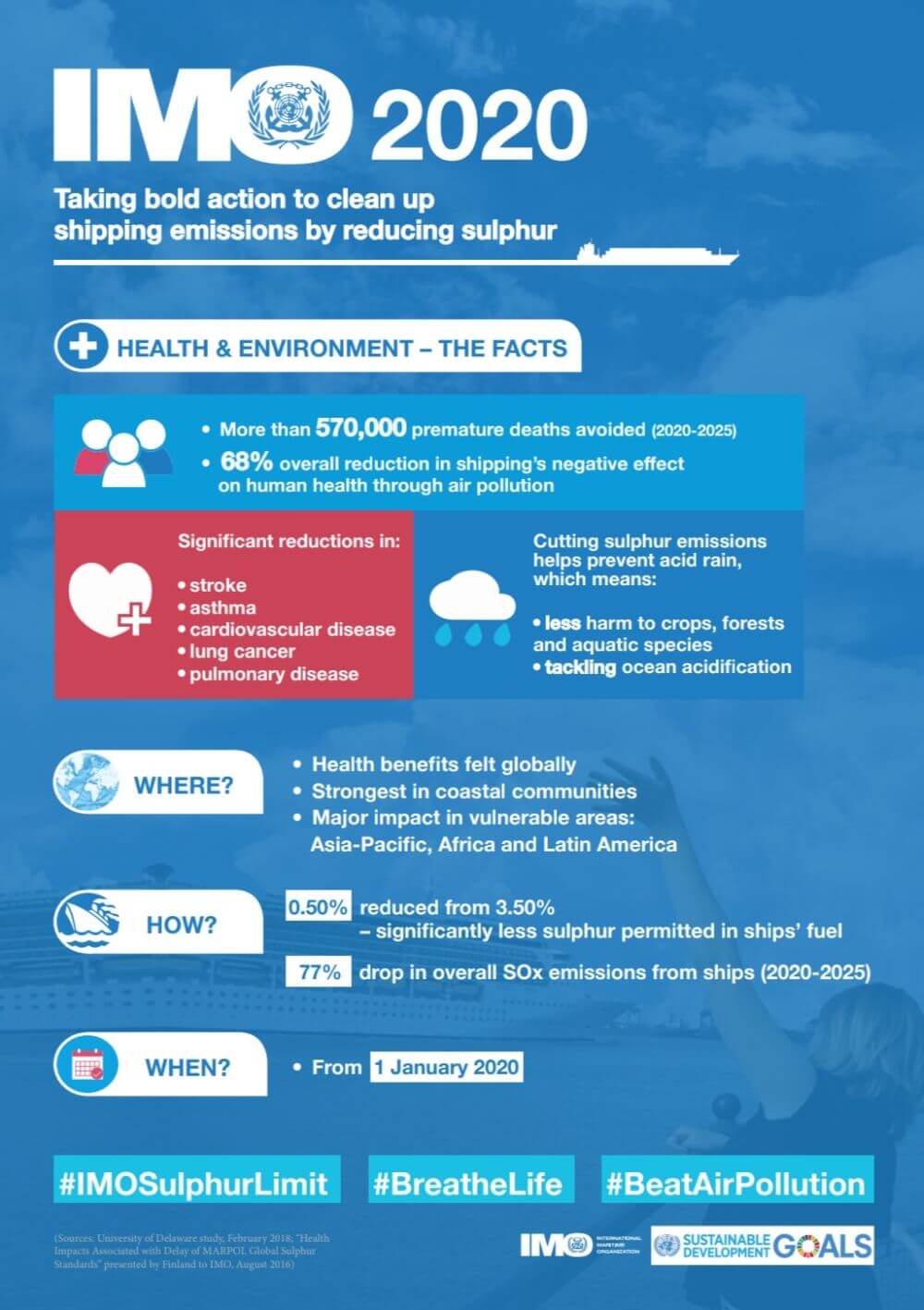
The IMO will require that all fuels used in ships contain no more than 0.50 percent sulfur.
“Public health experts estimate that once the 2020 sulfur cap takes effect, cleaner marine fuels will reduce ship-related premature mortality and morbidity by 34 and 54%, respectively, representing a ~ 2.6% global reduction in particulate matter 2.5 /PM2.5 cardiovascular and lung cancer deaths and a ~3.6% global reduction in childhood asthma.”
[source: Cleaner fuels for ships provide public health benefits with climate tradeoffs]
As the infographic by the International Maritime Organization illustrates below, new emission regulations taking effect in 2020 will have a significant impact on health and the environment.
IMO 2020 – A Breath of Fresh Air

You may also like

Urban heat local food production
Vibrant Agro industry