
London ; International GBC conduct the green rating of railway station as per IGBC-DCS green railway station rating standard followed in USA, UK, Europe, Japan, Russia, Australia and around 150 Countries of the world.
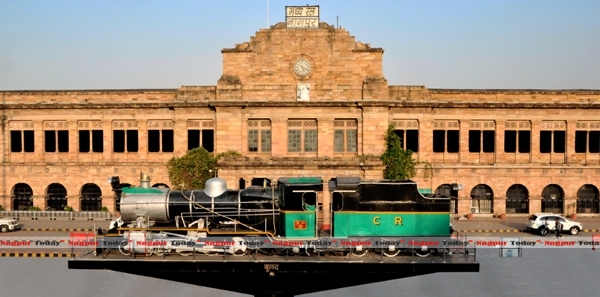 Nagpur Junction Railway Station is audited by Six Sigma Quality International http://www.ssqi.in http://www.ssqi.uk in 2020 and based on IGBC-DCS Green railway station Rating criteria, it is awarded as Gold Rating to Central railway https://cr.indianrailways.gov.in by International Green Building Council https//www.internationalgbc.org rating agencies of deming Rating http://www.demingworld.com

International Green Building Council (IGBC) has awarded Nagpur Junction Railway Station with Gold rating after it was declared a ‘green station’. The station scored 60 points out of 100 for its environment-friendly initiatives.
There are number of new initiatives are taken by Indian railway in last 5 years. Green rating is also one of the unique initiatives taken by Indian railway recently.
2020 awarded rating is Gold Rating

More than 100 years old and one of the busiest railway stations of the country, it achieved the Gold rating almost two years after getting its name is Nagpur Junction Railway station.
Talking to International GBC spokesperson on Monday, the divisional railway manager, Nagpur division of Central Railway, DRM said, “We secured maximum points in the category of Sustainable Station Facility (18) health, hygiene and sanitation (12) followed by energy efficiency (11) and water efficiency (8) Smart & Green Initiatives (8)and Innovation & Development (3) out of 100 Marks . This certification was possible due to the continuous efforts of all departments to improve and upgrade this station.
Sr DEE said that encouraged by this achievement, fresh efforts have been intensified to ensure improvement in all categories in order to secure the Platinum rating next year.
The officials said that International green building council -IGBC, with the support of environment directorate of British railway http://www.rail.co.uk/ Rail transportation in the United States https://www.transportation.gov/railroads, German Railway https://www.bahn.com/i/view/index.shtml, bullet train, is a network of high-speed railway lines in Japan, SNCF Réseau. France currently operates the second-largest European railway network https://www.railway-technology.com/projects/frenchtgv/ as well as Indian railways https://indianrailways.gov.in/ best practices has developed this rating system, which is a voluntary and consensus-based programme. It is a first of its kind holistic rating system in India to address environmental sustainability of Indian railway stations, they said.
“The overarching objective of the rating is to facilitate adoption of green concepts, thereby reducing the adverse environmental impact of station operation and maintenance, and enhancing the overall commuter experience,” added the officials. The rating system helps the station management to gauge the ‘green performance’ of the station and assess requirements for continuous improvement. The rating system is designed primarily for existing Indian railway stations, said the officials. “Many steps including training station operation and maintenance personnel on ‘Green Railway Station’, performance improvement and detailed study on opportunities for reducing energy and water consumption, increasing renewable energy, effective waste management, enhancing passenger amenities, guidance on implementation of green measures and facilitation of assessment by third party independent experts, are taken into account for the rating process.
Nagpur Junction (station code: NGP) is a railway station in Nagpur, in the Indian state of Maharashtra. It is an important junction station on the Howrah–Mumbai and Delhi–Chennai trunk line of the Indian Railways. It belongs to A1 category stations and is one of the top 100 booking stations of Indian Railways.
Nagpur railway station is one of the oldest and busiest stations in Maharashtra. Railways made a beginning in Nagpur in 1867, when a portion of the Bombay-Bhusaval-Nagpur line was opened for traffic. In 1881, it was connected to Kolkata via the Nagpur State Railway of Chhattisgarh.
The laying of the foundation stone of the existing building was done in 1906. It was officially inaugurated on 15 January 1925 by then Governor Sir Frank Sly. Before 1924, the original railway station was located towards the east of its current site near Shukrawari Lake. The present-day railway station was also put up in the pre-independence days. It has become a major tourist destination
Nagpur is divisional headquarter of two railway zones, Central Railway and South East Central Railway. Nagpur division has GT Route from Itarsi to Ballarshah and Mumbai-Howrah route from Gondia to Badnera. North-South and East-West traffic crisscrosses through the Division, making its Nagpur-Wardha section one of the busiest sections in Indian Railways. It has 3 branch lines connecting Amla-Chhindwara, Narkhed-Amravati & Majri-Pimpalkutti on Broad Gauge and one branch line Pulgaon-Arvi in Narrow Gauge . Shortest run by Indian Railways’ train is the scheduled services between Nagpur and Ajni stations situated just 3km from each other.
Around 254 Mail/Express and Passenger trains halt at the station, with approximately 160,000 passengers embarking and disembarking. 22 trains originate from and terminate at this station. Direct trains are available for most of the state capitals and major cities in india, including: Mumbai, New Delhi, Bengaluru, Hyderabad, Chennai, and Kolkata.
There are 6 railway stations within the extended city limit
| Station name | Station code | Railway zone | Total platforms |
|---|---|---|---|
| Ajni | AJNI | Central Railway | 3 |
| Itwari Junction | ITR | South East Central Railway | 6 |
| Kalamna | KAV | South East Central Railway | 3 |
| Khapri | KRI | Central Railway | 2 |
| Godhani | GNQ | Central Railway | 2 |
| Kamptee | KP | South East Central Railway | 3 |
