
Purification system for air
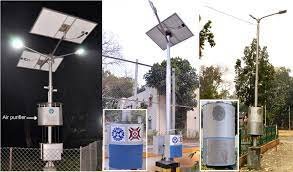
Purification system for air
courtesy : Purification system for air
Purifying techniques
There are two types of air purifying technologies, active and passive. Active air purifiers release negatively charged ions into the air, causing pollutants to stick to surfaces, while passive air purification units use air filters to remove pollutants. Passive purifiers are more efficient since all the dust and particulate matter is permanently removed from the air and collected in the filters. Several different processes of varying effectiveness can be used to purify air. As of 2005, the most common methods were high-efficiency particulate air (HEPA) filters and ultraviolet germicidal irradiation (UVGI).
Filtration
Air filter purification traps airborne particles by size exclusion. Air is forced through a filter and particles are physically captured by the filter. Various filters exist notably including:
- High-efficiency particulate arrestance (HEPA) filters remove at least 99.97% of 0.3-micrometer particles and are usually more effective at removing larger and smaller particles. HEPA purifiers, which filter all the air going into a clean room, must be arranged so that no air bypasses the HEPA filter. In dusty environments, a HEPA filter may follow an easily cleaned conventional filter (prefilter) which removes coarser impurities so that the HEPA filter needs cleaning or replacing less frequently. HEPA filters do not generate ozone or harmful byproducts in the course of operation.
- Filter HVAC at MERV 14 or above are rated to remove airborne particles of 0.3 micrometers or larger. A high-efficiency MERV 14 filter has a capture rate of at least 75% for particles between 0.3 and 1.0 micrometers. Although the capture rate of a MERV filter is lower than that of a HEPA filter, a central air system can move significantly more air in the same period of time. Using a high-grade MERV filter can be more effective than using a high-powered HEPA machine at a fraction of the initial capital expenditure. Unfortunately, most furnace filters are slid in place without an airtight seal, which allows air to pass around the filters. This problem is worse for the higher-efficiency MERV filters because of the increase in air resistance. Higher-efficiency MERV filters are usually denser and increase air resistance in the central system, requiring a greater air pressure drop and consequently increasing energy costs.
- There is ongoing research to enable viable and effective biocide treated air filters (i.e. air filters coated with antimicrobial agents) for preventing the spread of airborne pathogens.
Other methods
Ultraviolet germicidal irradiation – UVGI can be used to sterilize air that passes UV lamps via forced air. Air purification UVGI systems can be freestanding units with shielded UV lamps that use a fan to force air past the UV light. Other systems are installed in forced air systems so that the circulation for the premises moves micro-organisms past the lamps. Key to this form of sterilization is the placement of the UV lamps and a good filtration system to remove the dead micro-organisms. For example, forced air systems by design impede line-of-sight, thus creating areas of the environment that will be shaded from the UV light. However, a UV lamp placed at the coils and drain pan of the cooling system will keep micro-organisms from forming in these naturally damp places. The most effective method for treating the air rather than the coils is in-line duct systems, these systems are placed in the center of the duct and parallel to the airflow.
# Purification system for air
#ultraviolet germicidal irradiation (UVGI)
#sterilization is the placement
#ISBC

You may also like

Urban heat local food production
Vibrant Agro industry

