
Climate change
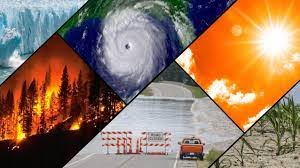
Climate change
courtesy : Climate change
Climate change feedback
Sea ice reflects 50% to 70% of incoming sunlight, while the ocean, being darker, reflects only 6%. As an area of sea ice melts and exposes more ocean, more heat is absorbed by the ocean, raising temperatures that melt still more ice. This process is a positive feedback.
The response of the climate system to an initial forcing is modified by feedback : increased by “self-reinforcing” or “positive” feedback and reduced by “balancing” or “negative” feedback. The main reinforcing feedback are the water-vapour feedback, the ice–albedo feedback, and the net effect of clouds. The primary balancing mechanism is radioactive cooling, as Earth’s surface gives off more heat to space in response to rising temperature. In addition to temperature feedback, there are feedback in the carbon cycle, such as the fertilizing effect of CO2 on plant growth. Uncertainty over feedback is the major reason why different climate models project different magnitudes of warming for a given amount of emissions.
As the air is warmed by greenhouse gases, it can hold more moisture. Water vapour is a potent greenhouse gas, so this further heats the atmosphere. If cloud cover increases, more sunlight will be reflected back into space, cooling the planet. If clouds become higher and thinner, they act as an insulator, reflecting heat from below back downwards and warming the planet. The effect of clouds is the largest source of feedback uncertainty.
Another major feedback is the reduction of snow cover and sea ice in the Arctic, which reduces the reflectivity of the Earth’s surface. More of the Sun’s energy is now absorbed in these regions, contributing to amplification of Arctic temperature changes. Arctic amplification is also melting permafrost, which releases methane and CO2 into the atmosphere. Climate change can also cause methane releases from wetlands, marine systems, and freshwater systems. Overall, climate feedback are expected to become increasingly positive.
Around half of human-caused CO2 emissions have been absorbed by land plants and by the oceans. On land, elevated CO2 and an extended growing season have stimulated plant growth. Climate change increases droughts and heat waves that inhibit plant growth, which makes it uncertain whether this carbon sink will continue to grow in the future. Soils contain large quantities of carbon and may release some when they heat up. As more CO2 and heat are absorbed by the ocean, it acidifies, its circulation changes and phytoplankton takes up less carbon, decreasing the rate at which the ocean absorbs atmospheric carbon. Overall, at higher CO2 concentrations the Earth will absorb a reduced fraction of our emissions.
#Climate change
#Climate change feedback
#Climate sensitivity
#isbc

You may also like

Urban heat local food production
Vibrant Agro industry

