
Desalinated water
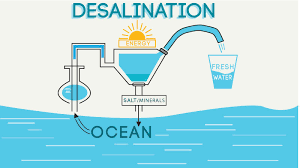
Desalinated water
courtesy : Desalinated water
Desalination
As populations increase and sources of high quality, fresh drinking water decrease, using desalination processes to provide fereshwater has increased in many olaces when other sources and treatment procedures are uneconomical or not environmentally responsible. Desalination is any process that removes excess salts and other minerals from water. In most desalination processes, water (seawater or groundwater) is treated and two streams of water are produced:
- Treated freshwater that has low concentrations of salts and minerals.
- Concentrate or brine, which has salt and mineral concentrations higher than that of the feed water.
The feed water for desalination processes can be seawater or brackish water. Brackish water contains more salt than fresh water and less than salt water.
Today there are more 18,426 than desalination plants worldwide producing more than 86.8 million cubic meters per day. There are 150 countries where desalination is practiced supplying more than 300 million people round the world who rely on desalinated water for some or all of their daily needs.
Thermal distillation and membrane processes are the two main approaches used around the world to desalinise water. Desalination processes may be used in municipal, industrial, or commercial applications. With improvements in technology, desalination processes are becoming cost-competitive with other methods of producing usable water to respond to a growing demand. Stand-alone desalination plants can use renewable energy to operate. The pure water that is obtained after desalination must be re-mineralised to be adequate for human consumption. The concentrated brine produced in desalination processes needs to be disposed of properly.
The main advantages of desalination plants are that they use an abundant water source (seawater), that they allow drinking water production in arid, coastal regions and that many processes available can be adapted to different local context.
The main disadvantages of desalination plants are the high energy consumption and/or investment costs, the production of highly concentrated salty water as a by-product that has to be discharged properly and that desalinated water has to be remineralised before it becomes drinking water.
#desalination plants
#Thermal distillation
#international green building council

You may also like

Urban heat local food production
Vibrant Agro industry

