
EV charging point
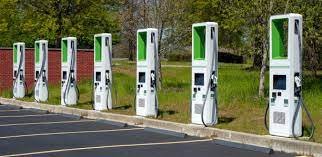
EV charging point
courtesy :EV charging point
Charging station
The free encyclopedia
- Top-left: a Tesla Roadster (2008) being charged at an electric charging station in Iwata city, Japan.
- Top-right: Brammo Empulse electric motorcycle at an AeroVironment charging station.
- Bottom-left: Nissan Leaf recharging from a NRG Energy eVgo station in Houston, Texas.
- Bottom-right: converted Toyota Priuses recharging at public charging stations in San Francisco (2009).
A charging station, also known as a charge point or electric vehicle supply equipment (EVSE), is a piece of equipment that supplies electrical power for charging plug-in electric vehicles (including electric cars, electric trucks, electric buses, neighborhood electric vehicles, and plug-in hybrids).
There are two main types: AC charging stations and DC fast chargers. Batteries can only be charged with direct current (DC) electric power, while most electricity is delivered from the power grid as alternating current (AC). For this reason, most electric vehicles have an onboard charger with an AC-to-DC converter (a rectifier). At an AC charging station, power is supplied to the onboard charger. DC fast chargers facilitate higher power charging, which requires much larger AC-to-DC rectifiers, so the converter is built as part of the charging station and DC power is supplied directly to the vehicle, bypassing the onboard converter. Most fully electric car models can accept both AC and DC power.
Charging stations provide connectors that conform to a variety of international standards. DC charging stations are commonly equipped with multiple connectors to be able to charge a wide variety of vehicles that utilize competing standards.
Public charging stations are typically found street-side or at retail shopping centers, government facilities, and other parking areas. Private charging stations are typically found at residences, workplaces, and hotels.
Standards
Multiple standards have been established for charging technology to enable interoperability across vendors. Standards are available for nomenclature, power, and connectors. Notably, Tesla has developed proprietary technology in these areas, and built its charging networking starting in 2012.
Nomenclature
In 2011, the European Automobile Manufacturers Association (ACEA) defined the following terms:
- Socket outlet: the port on the electric vehicle supply equipment (EVSE) that supplies charging power to the vehicle
- Plug: the end of the flexible cable that interfaces with the socket outlet on the EVSE. In North America, the socket outlet and plug are not used because the cable is permanently attached.
- Cable: a flexible bundle of conductors that connects the EVSE with the electric vehicle
- Connector: the end of the flexible cable that interfaces with the vehicle inlet
- Vehicle inlet: the port on the electric vehicle that receives charging power
The terms “electric vehicle connector” and “electric vehicle inlet” were previously defined in the same way under Article 625 of the United States National Electric Code (NEC) of 1999. NEC-1999 also defined the term “electric vehicle supply equipment” as the entire unit “installed specifically for the purpose of delivering energy from the premises wiring to the electric vehicle”, including “conductors electric vehicle connectors, attachment plugs, and all other fittings, devices, power outlets, or apparatuses”.
Tesla, Inc. uses the term charging station as the location of a group of chargers, and the term connector for an individual charger.
#Automobile Manufacturers Association (ACEA)
#direct current (DC)
#The free encyclopedia
#Nomenclature
# isbc

You may also like

Urban heat local food production
Vibrant Agro industry

