
Jupiter exploration
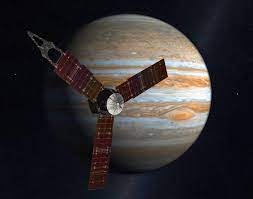
Jupiter exploration
courtesy : Jupiter exploration
Technical requirements
Flights from Earth to other planets in the Solar System have a high energy cost. It requires almost the same amount of energy for a spacecraft to reach Jupiter from Earth’s orbit as it does to lift it into orbit in the first place. In astrodynamics, this energy expenditure is defined by the net change in the spacecraft’s velocity, or delta-v. The energy needed to reach Jupiter from an Earth orbit requires a delta-v of about 9 km/s, compared to the 9.0–9.5 km/s to reach a low Earth orbit from the ground. Gravity assists through planetary flybys (such as by Earth or Venus) can be used to reduce the energetic requirement (i.e. the fuel) at launch, at the cost of a significantly longer flight duration to reach a target such as Jupiter when compared to the direct trajectory. Ion thrusters capable of a delta-v of more than 10 km/s were used on the Dawn spacecraft. This is more than enough delta-v to do a Jupiter fly-by mission from a solar orbit of the same radius as that of Earth without gravity assist.
A major problem in sending space probes to Jupiter is that the planet has no solid surface on which to land, as there is a smooth transition between the planet’s atmosphere and its fluid interior. Any probes descending into the atmosphere are eventually crushed by the immense pressures within Jupiter.
Another major issue is the amount of radiation to which a space probe is subjected, due to the harsh charged-particle environment around Jupiter (for a detailed explanation see Magnetosphere of Jupiter). For example, when Pioneer 11 made its closest approach to the planet, the level of radiation was ten times more powerful than Pioneer‘s designers had predicted, leading to fears that the probes would not survive. With a few minor glitches, the probe managed to pass through the radiation belts, but it lost most of the images of the moon Io, as the radiation had caused Pioneer‘s imaging photo polarimeter to receive false commands. The subsequent and far more technologically advanced Voyager spacecraft had to be redesigned to cope with the radiation levels. Over the eight years the Galileo spacecraft orbited the planet, the probe’s radiation dose far exceeded its design specifications, and its systems failed on several occasions. The spacecraft’s gyroscopes often exhibited increased errors, and electrical arcs sometimes occurred between its rotating and non-rotating parts, causing it to enter safe mode, which led to total loss of the data from the 16th, 18th and 33rd orbits. The radiation also caused phase shifts in Galileo‘s ultra-stable quartz oscillator.
Every Jupiter mission ever
By studying Jupiter we learn about how our solar system formed and evolved, and how countless others in the galaxy and beyond do as well. Jupiter’s four planet-like moons have features like volcanoes and subsurface oceans, making Jupiter a miniature Solar System of its own. Jupiter is not only an interesting scientific destination but also an important waypoint for spacecraft heading further into the Solar System. The gas giant’s immense gravity field can provide a boost and trajectory change for spacecraft heading to even further destinations
#solar system
#Jupiter exploration
#Pioneer
#ISBC

You may also like

Urban heat local food production
Vibrant Agro industry

