
Vertical Gardening
Courtesy : agritech.tnau.ac.in
Vertical Gardening
| VERTICAL GARDENING |
|---|
|
|||||||||||||||||||||||||||||||||||
Green facades are a type of green wall system in which climbing plants or cascading groundcovers are trained to cover specially designed supporing structures. Rooted at the base of these structure, in the ground, in intermediate planters or even on achieving full coverage. Green facades can be anchored to existing walls or built as freestanding structure, such as fences or columns
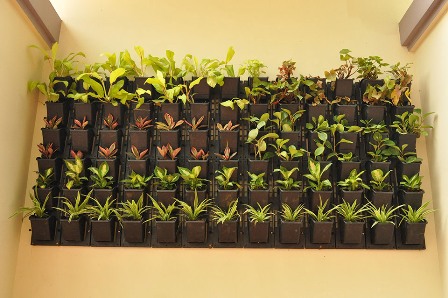
Modular green wall : Vertical Garden Modules is made up of recycled poly propylene material. It has attractive look, highly durable in nature and it can be easily installed. It provides instant solution for making garden in your residing place.
|
|||||||||||||||||||||||||||||||||||
|
|||||||||||||||||||||||||||||||||||
|
Choosing the plants : The best plants for vertical gardens are dense, compact and low growing. Make sure you choose species that suit the aspect of the wall on which they’ll be growing. A wall drenched in sun, for instance, will need a selection of fairly drought-tolerant plants, whereas a shady spot – perhaps under a pergola or verandah – will require a selection of shade lovers, such as ferns. Also bear in mind that the bottom of the unit will hold more moisture than the top, so consider this when you’re deciding what to plant where. Plants suitable for vertical garden : Outdoor plants Peperomia, Syngoniums, Philodendron, Epipremnum, Begonia, Anthuriums, Nephrolepis, Chlorophytum, Lantana, Pilea, Rheo discolor, Cuphea, Fittonia, Spathiphylum, Schefflera
Indoor Green walls/ For shaded areas:
For Outdoors/Exterior Green walls:
|
|||||||||||||||||||||||||||||||||||
| Growing media:
Requirements:
Cocopeat, Perlite, Sphagnum moss, vermiculite, vermicompost, shredded bark and leaf molds are the common media combinations used. Soil in not used since it increases the weight of the green walls. There are three types of growth media used in living walls:
|
|||||||||||||||||||||||||||||||||||
|
|||||||||||||||||||||||||||||||||||
|
Irrigation and plant nutrition: Green walls cannot be sustained without irrigation. Interruptions to the water supply are a common cause of plant failure on green walls. Systems designed with inbuilt irrigation should mitigate plant losses due to inconsistent moisture management, although errors can still occur. Automated, remotely controllable irrigation systems are used for walls in high profile locations, or in situations where access is challenging. Note that the quality, design and costs will vary between different systems. The most sophisticated systems enable the maintenance supervisor to keep track of the automated performance of the system, including the volume of irrigation delivered, its frequency, substrate moisture content, as well as pH and nutrient levels in the water supply. The settings can be overridden if needed; for instance, the frequency or duration of irrigation cycles may be increased on hot days. In hydroponic systems, plant nutrition is delivered by a fertilizer injection system that releases controlled doses of fertiliser into the irrigation system (fertigation). Management of fertigation systems and rates of delivery requires specialist knowledge, as it is more complex than fertilizing soil or growing media. Hydroponic systems require continual monitoring of pH, water hardness and total dissolved solids (TDS), and adjustment of these parameters where necessary. Irrigation: The irrigation system is designed to minimize water consumption. It consists of an automation-unit with equipment for control of nutrient injection and irrigation cycles. When a surface has a variation of sun exposures, the irrigation is divided into segments in order to program it specifically for each part. Within the multi-layered felt surface a drip-tube is integrated. Water consumption varies with heat and sun exposure, but compared to normal green spaces or a lawn, the consumption is normally lower.
For hydroponic green wall systems, the fertigation system may apply 0.5-20 litres of irrigation solution per square metre perday. Internal green wall requirements are at the lower end of this range, and external green walls at the higher end. Irrigation cycles typically last a few minutes and will be required several times a day. Keeping irrigation volumes low minimises waste and reduces run-off. Irrigation run-off may be captured in a tank at the base of the wall and recycled back through the green wall system. Green walls that use a high quality, water-retentive growing medium, and are not in an exposed or particularly hot location, may thrive on a weekly watering regime. In most simple, soil-based systems, including DIY systems, controlled release fertiliser is mixed in with the growing medium, rather than using a fertigation system. Irrigation must be available as soon as the plants are installed in the wall system. The irrigation system requires a water meter to monitor irrigation volume, and a pressure gauge to monitor the even application of water. The need for ongoing regular irrigation and the expectation that water will be used sustainably means that stored (harvested or recycled) water should be used whenever possible, so a pump is necessary.
Design / process: Each vertical garden is given a unique design and selection of species. The composition of plants takes in consideration the specific environment where it will be built, such as the local- and micro climate, sun exposure and the surrounding context. The aim is to create a one of a kind and site-specific garden that stands beautiful through all the seasons of the year.
A well executed design is also a way to minimize the future maintenance demand of the garden. A plant’s growth habit, size and behavior on a vertical surface is important knowledge for making the right combination of species, in order to keep the competition between plants at a healthy level. Choosing the right plant for the right place makes sense for any garden, but maybe even more so in a vertical garden..
A vertical garden can be installed in almost any location and as a living material, the potential of integrating plants in our urban environments is interesting. Places never thought of as possible could be inhabited by plants, like subway stations or other intensely frequented places where horizontal space is difficult to spare. |
|||||||||||||||||||||||||||||||||||
|
|||||||||||||||||||||||||||||||||||
Benefits of Vertical gardening:
|
|||||||||||||||||||||||||||||||||||
DIY ( Do it Yourself) :
|
|||||||||||||||||||||||||||||||||||
Vertical pillars:
|
|||||||||||||||||||||||||||||||||||
Certain DIY ideas for you to make simple and low cost vertical gardens in your houses
|
|||||||||||||||||||||||||||||||||||
Green walls in various locations:
|
|||||||||||||||||||||||||||||||||||


You may also like
Urban heat local food production
Vibrant Agro industry