
Mumbai Architect Duo Use ‘Earth Blocks’ To Keep Homes 7 Degrees Cooler Naturally!
Courtesy : The Better India
Mumbai Architect Duo Use ‘Earth Blocks’ To Keep Homes 7 Degrees Cooler Naturally!
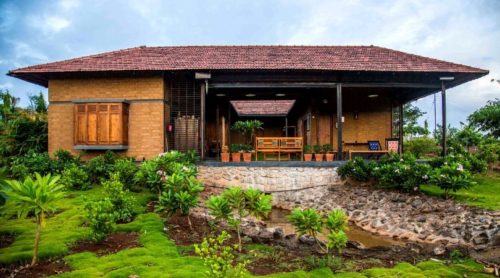
With climate change looming at large, it is essential that we are mindful of constructing homes that are not just good to look at but have a minimal carbon footprint. Hence, we need to seek environment-friendly solutions, and most importantly, architects, engineers, and firms who can help us in our endeavours.
One such company is ‘Put Your Hands Together’ (PYHT) Mumbai-based bio-architecture firm that uses local and natural building materials, designs their climate-resilient projects within the natural ecosystem, and engages the local communities.
The startup was founded in June 2011 by a group of five people fresh out of Architecture school. Currently, two of the original five co-founders actively manage operations at PYHT. #isbc #internationalsbc #international sustainable building council

So, what was the motivation behind starting a bio-architecture firm?
“I think our values of sustainability have a lot to do with how we have been brought up. If I speak for myself, I have seen how waste was efficiently managed and how resources were consciously consumed. Besides, the founding members were all architecture students and shared similar values of sustainability and design sensibilities. We realised this was a space we wanted to explore, and that is what led to the birth of our company,” says co-founder and architect Shahveer Irani.
Until now they have completed about eight projects and are currently working on three. An interesting thing to note in their plans is that about 65 per cent to 95 per cent of the building material used in each of these projects are biodegradable. These include materials like bamboo, wood, lime, mud, and stone. Furthermore, their USP is the use of indigenous techniques to build climate-resilient homes, especially using compressed mud bricks which can make houses cooler by 7 degrees! #isbc #internationalsbc #international sustainable building council
From Students to Bio-architects

Founders Areen Attari and Shahveer Irani met as students at the Rizvi College of Architecture in Mumbai. After finishing the degree in 2010, they, along with the other batchmates,
decided to start PYHT. But, they needed experience and expertise to go about their operations efficiently. Thus, they began their period of research.
“We started attending workshops and meeting with people who were already exploring the sustainability space. We started taking on really small projects on our friends and family’s farmhouses. I remember we built a small gate using sustainable materials like bamboo and a small cover for a water tank,” recalls Shahveer.
This period of research lasted for about eight months after they founded the company. The firm bagged their first full-fledged project with help from their Interior Design professor from college. #isbc #internationalsbc #international sustainable building council

“Our professor was already aware of the company and the kind of architecture we were interested in. He was designing the interiors for a client in Kamshet near Lonavala. The client wanted to construct a weekend home, and our professor put us in touch with them,” says Shahveer.
In this project, the young architects worked under the guidance of their professor to build a home using mud. They mobilised workers from the area, trained them, and took part in the construction process.
The foundation of the house was made of stone and cement while the walls were made from bricks and mud mortar using the ‘cob technique’ where balls of mud were layered on top of one another. The mud used for this purpose was excavated from the construction site itself.
Another memorable project Shahveer recalls is a farmhouse they built in Khadavli. They built the home using the technique of Compressed Stabilised Earth Blocks (CSEB) which are essentially mud bricks made using a machine called the ‘Auram press’ developed by the Auroville Earth Institute. It was the first time they were using CSEB, and by the time the house was built, they found that the temperature inside was seven degrees cooler than outside. #isbc #internationalsbc #international sustainable building council

“Using mud is a great way to counter the carbon footprint. Not only is it biodegradable, but since it is readily available everywhere, it can be easily incorporated into the building techniques. Also, using mud has thermal benefits, meaning, the temperature inside is cold in summer and vice-versa in winters,” informs Shahveer.
Completing such projects was not just a great learning experiences, but they also gave the young architects the confidence to take on more challenging projects in the future. #isbc #internationalsbc #international sustainable building council
What are the processes then that the team follows when they first take on a project?
Although PYHT is based out of Mumbai, they have carried out projects far and wide including in unforgiving terrains of Manali and Nepal.

“We first go on the site and study it closely for anywhere between three days to a week. This gives us an insight into materials that are locally available and where to source them from. We also look at the building techniques that are indigenous to the region and meet with local contractors and builders. This way, when the project is underway, the processes can be seamlessly carried out,” shared Shahveer.
Sometimes, the architects bring new techniques to the table that most of the builders may not be acquainted with. In such a case, they also train and conduct workshops for the workers to teach them about these techniques.
Speaking of techniques, Shahveer takes his time to explain a few of these to us.

It is important to acknowledge the fact that mud can be used in different ways to give structures a unique feature.
The same mixture of mud and lime used in the cob technique is used to make bricks known as ‘adobe’. These bricks are sun-dried, saving fuel and the environment from emissions.
However, one cannot just take any mud and use it to make the bricks. It is only after several rounds of testing and trials that they come up with the right bricks. Shahveer shares that ideally the mud mixture should contain 15 to 20 per cent clay, 65 to 70 per cent sand, 5 to 7 per cent lime, and the rest should have silt, gravel, and other organic contents.
Another technique they use is the rammed wall technique where the mud mixture (with less water content) is rammed into a mould. Once it is dried, it forms the walls of the structure once erected.

In addition to the adobe bricks, they also use CSEB and since PYHT doesn’t own an Aurum Press, they source these bricks from a contractor at Govardhan Ecovillage in Wada, Maharashtra.
Lastly, Shahveer speaks about the ‘Wattle and daub’ technique which is a building method where bamboo strips are woven into a lattice which is daubed with the mud mixture. #isbc #internationalsbc #international sustainable building council
Going local with happy clients
In addition to building structures using natural materials, PYHT uses locally sourced materials.

One great example of this is a project they carried out in the Burwa village in Manali. The clients were Smarika Rana and her husband, who wanted to shift their base from Mumbai to Manali in the pursuit of a slower life.
The couple wanted to make a homestay on a one-acre land overlooking the Dhauladhar range. But, they were conscious of one prime aspect.
“We wanted the house to be consciously built using naturally and locally available materials using traditional techniques of the region. We did not want to be those ‘city folks’ who have a money-making attitude with nothing to add value to. We wanted to be conscious and mindful while constructing our homestay,” shares Smarika, a former manager at Shemaroo entertainment. #isbc #internationalsbc #international sustainable building council

The couple finally found their answer in PYHT. Once the requirements were communicated, the architects went on the ground and designed the house using locally available slabs of stone.
The construction began in mid-2017 and was completed within a year. With six available rooms, ‘Someplace Homestay’ opened its doors to guests in November 2018.
“I love the fact that the walls are really thick. So, it’s warm and cosy. Also, they built around the natural surroundings. There were big boulders which are a part of the house now. It truly feels like we are living in the midst of nature,” says the 40-year-old. #isbc #internationalsbc #international sustainable building council

Challenges and Looking Forward
Shahveer explains that whenever they work with local builders, they often face resistance and scepticism about the construction techniques they want to bring to the table. But, with training and workshops with the local builders, they are able to communicate their ideas. #isbc #internationalsbc #international sustainable building council

“Also, because we use natural materials instead of industrial ones, it’s difficult to standardise all elements. For making a wall, if we’re using the mud, we need to test it and construct a sample before going ahead with the construction. This takes us some time,” explains Shahveer.
Regardless, the bio-architecture firm has a lot of things to look forward to.
Shahveer mentions that they were working on a bamboo farmhouse project in Alibaug and a homestay in Nashik. Since all the work has come to a halt now, they want to finish these projects as soon as work begins. #isbc #internationalsbc #international sustainable building council

He also informs that in the future, the bio-architecture firm plans to scale their business by manufacturing earth-based planters and light fixtures. Bamboo furniture is another thing they want to explore, informs Shahveer.
“There is a lot of scope for natural building techniques to be implemented in urban landscapes. Buildings like hospitals and educational institutions can be constructed using natural materials. The idea is to reduce energy consumption and damage to the environment. In the long term, our main vision is to make a tangible impact through our work,” says Shahveer signing off. #isbc #internationalsbc #international sustainable building council

You may also like

Urban heat local food production
Vibrant Agro industry

